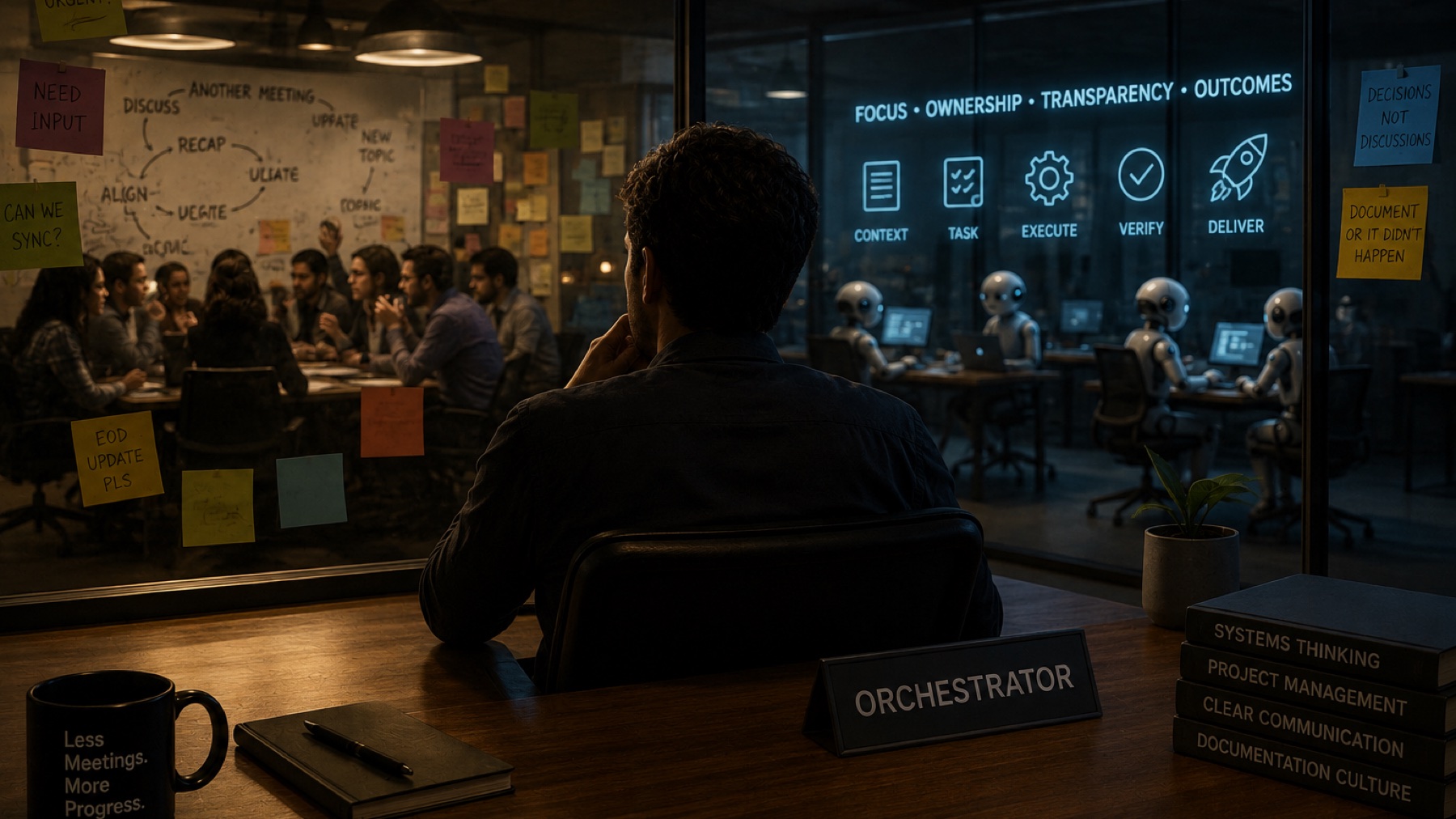
The biggest lesson I learned from AI agents was not how to build software faster.
It was how much organisational friction we have accepted as normal.
The more I work with teams of specialist agents, the less I think they are teaching us about artificial intelligence. They are teaching us about ourselves: how we preserve context, divide responsibility, make decisions, verify work, and recover when something goes wrong.
Ironically, one of the most human leadership lessons I have learned did not come from a manager, a leadership book, or an MBA.
It came from watching an orchestrator agent coordinate other agents.
Not because it was smarter.
Because it was disciplined.
The best “manager” in the room barely does the work
When people imagine an AI development team, they picture coding agents flying through thousands of lines of code while humans stare nervously at a progress bar.
That is not the part I find most interesting.
The most valuable agent is often the orchestrator. It does not try to become the best frontend engineer, backend engineer, designer, researcher, and quality specialist at the same time.
Instead, it does a few less glamorous things well:
- It establishes the objective and keeps the shared context available.
- It gives each specialist a bounded task and a definition of done.
- It notices dependencies and removes blockers.
- It verifies outputs before treating activity as completion.
- It records what happened so the next step does not begin from memory.
In other words, it manages the system around the work.
Then I started wondering: why do so many companies make this harder for people than we make it for agents?
Somewhere, the meeting became the product
We have all attended this meeting.
| Person | Contribution |
|---|---|
| Person A | “Just to recap…” |
| Person B | “Wait—wasn’t that discussed last week?” |
| Person C | “I thought someone was documenting it.” |
| Person D | “Let’s schedule another session with the wider team.” |
Forty-five minutes later, the only thing successfully produced is another calendar invitation.
The problem is not that meetings are bad. Some decisions improve when people can challenge assumptions, read the room, or solve an unclear problem together.
The problem is that many meetings are not decision sessions. They are context-recovery sessions. People reconstruct what was agreed, search for missing information, discover that ownership was assumed rather than assigned, and leave with another round of follow-ups.
The calendar is busy because the operating system is forgetful.
Many organisations do not have a meeting problem. They have a context problem that meetings are being asked to repair.
Agents do not necessarily have better memories. They have better systems
An agent team works only when context is made explicit. Goals, constraints, source material, task boundaries, tools, outputs, and verification steps have to exist somewhere the system can use them.
Humans can compensate for missing structure in ways machines cannot. We remember half a conversation, interpret a raised eyebrow, message someone privately, and quietly fix an unclear handoff. That flexibility is useful. It also allows poor systems to survive for years.
The contrast is revealing:
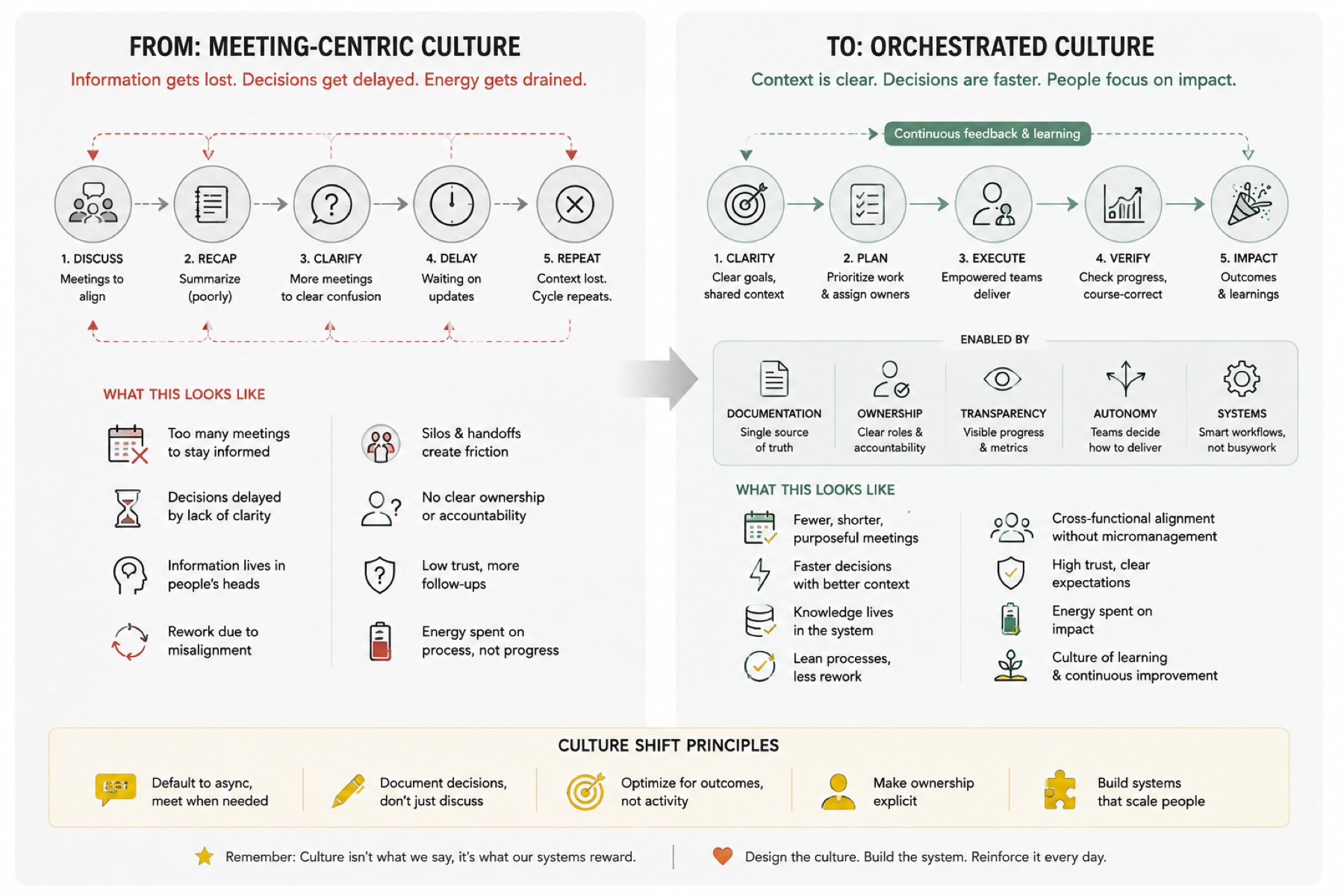
| Meeting-centric organisation | Orchestrated organisation |
|---|---|
| Information lives inside people | Shared context lives in accessible systems |
| Meetings repeatedly create alignment | Clear goals and decisions preserve alignment |
| Specialists wait for updates | Specialists work from current context and explicit ownership |
| Decisions fade after the conversation | Decisions become organisational memory |
| Progress depends on who is available | Progress continues through visible handoffs and boundaries |
| Activity is easy to see | Outcomes and learning are easier to inspect |
None of this is really about AI.
It is about operating design.
Documentation is not bureaucracy. It is organisational memory
For years, many companies have treated documentation as administrative work: something to do if there is time, once the real work is finished.
Agent systems make the weakness in that idea obvious. If important context is not available to the system, it effectively does not exist. A missing constraint is not a small inconvenience; it changes the work that gets produced.
The same is true inside organisations, although people are better at hiding the cost.
Useful documentation does not mean recording everything. Nobody needs a twelve-page account of a five-minute choice. It means preserving the information another person will need to act without reconstructing the past:
- What are we trying to achieve?
- What decision was made, and why?
- Who owns the next move?
- What constraints or risks matter?
- What would count as complete?
- Where should new evidence change the direction?
Every clear requirement becomes reusable. Every recorded decision reduces future ambiguity. Every visible handoff gives the next person a better starting point.
Good documentation does not slow an organisation down. It prevents the organisation from repeatedly paying the same thinking tax.
Input → Process → Output still explains most of it
One mental model has helped me understand businesses, products, and AI systems:
Input → Process → Output
It is deliberately simple. Simple models are useful when they help us notice what complexity is hiding.
| Stage | Inside an organisation | The question to ask |
|---|---|---|
| Input | Goals, customer problems, evidence, requirements, people, budgets | Is the work beginning with enough clarity and context? |
| Process | Decisions, collaboration, execution, review, escalation | Are ownership, handoffs, boundaries, and feedback visible? |
| Output | Products, customer value, decisions, learning, documentation | Did the system create an outcome and preserve what it learned? |
Most organisations obsess over the middle. They add meetings, dashboards, status updates, and project rituals to improve execution.
Far fewer improve the beginning.
Feed an AI vague requirements and you will probably get vague software. Feed a company vague priorities and you will probably get vague execution—only with more people invited.
This connects directly to why good software still depends on judgment and why modern builders need systems thinking alongside AI orchestration. Better execution cannot rescue an unclear objective indefinitely.
Specialists create excellence. Orchestrators create leverage
The orchestrator is not valuable because it knows everything. It is valuable because it understands enough to connect the work into one coherent system.
That distinction matters for careers as much as it does for AI.
Deep specialists remain essential. Without them, the work becomes broad but shallow. Yet expertise creates more value when somebody can connect customer need, business logic, product choices, technical dependencies, human behaviour, risk, and delivery.
The highest-leverage person is often not the loudest person in every discussion. It is the person who can:
- Frame the outcome clearly.
- Bring the right expertise into the decision.
- Translate between disciplines without flattening their differences.
- Make ownership and constraints explicit.
- Create a feedback loop that improves the next decision.
That is leadership.
That is systems thinking.
That is project management when it is treated as an operating capability rather than a reporting function.
But people are not agents
The analogy has limits, and those limits matter.
People need trust, meaning, autonomy, recognition, psychological safety, and room to question the objective itself. A person should not be reduced to a specialist process waiting for the orchestrator to issue another task.
Good organisational systems create clarity without creating obedience. They make ownership explicit while leaving room for judgment. They reduce avoidable coordination so people can spend more energy on the ambiguity, creativity, relationships, and ethical choices that require human attention.
This is why I prefer the idea of redesigning how work happens because of AI, rather than merely automating the existing workflow. The goal is not to make people behave more like machines. It is to stop wasting people on work a better system could remove.
Maybe we have been measuring productivity incorrectly
For years, organisations have celebrated visible busyness:
- Back-to-back meetings
- Constant availability
- Rapid replies
- Frequent status updates
- Full calendars that look suspiciously like achievement
What if these are sometimes symptoms rather than strengths?
What if healthier organisations are the ones where meetings become shorter because context already exists; ownership is obvious without asking; decisions are documented instead of remembered; and specialists spend more time producing than synchronising?
A useful operating system makes progress easier to inspect without demanding a performance of busyness. It connects information to decisions and decisions to action—the same reason a decision system is more valuable than another dashboard.
The shift can begin with five practical defaults:
- Default to asynchronous context. Meet when discussion changes the outcome, not simply to distribute information.
- Document decisions, not every conversation. Preserve the choice, reasoning, owner, and next action.
- Optimise for outcomes, not visible activity. Ask what changed for the customer, team, or business.
- Make ownership explicit. Shared responsibility should not mean unowned responsibility.
- Build feedback into the system. Verification and learning should change the next plan.
Culture is what the system rewards
Culture is not only what a company says it values.
It is the collection of systems that quietly determines how work gets done: what receives attention, which behaviour is rewarded, where information lives, who can make a decision, how mistakes are handled, and whether learning survives the project that produced it.
The biggest lesson AI agents have taught me is not that machines are becoming more human.
It is that humans can become much better at designing the environments in which they work.
Perhaps the future of company culture is not another meeting, another dashboard, or another slogan on an office wall.
Perhaps it is an organisation where context compounds, decisions are preserved, ownership is clear, and people spend more time creating than remembering.
If AI agents can remind us of that, they have already changed far more than software.