
Not because marketing is unimportant. Because it is too important to understand only from inside the marketing department.
Let me begin with a conversation that has probably happened in some form inside thousands of companies.
Marketing: We need to reposition this as a premium product.
Finance: How premium is the margin?
Operations: We cannot consistently deliver the current promise.
Product: The feature in the campaign is still in development.
Customer Support: Customers have been complaining about the basic experience for six months.
Marketing: Understood. Can we make the logo slightly bigger?
I am exaggerating.
Slightly.
This is why I think every marketer should spend at least one year outside marketing.
I do not necessarily mean resigning tomorrow, updating LinkedIn to “recovering marketer,” and joining the finance department with a calculator. I mean deliberately spending enough time inside the other functions of a business that marketing stops looking like the final layer of communication and starts looking like what it really is: the discipline that connects customer value to business value.
Marketing is one of the most cross-functional jobs in a company. Yet many marketers develop in increasingly narrow lanes: performance, social, brand, content, CRM, media, analytics, design, or communications. Those specialisms matter. The problem begins when the channel becomes the worldview.
A paid-media dashboard can tell you that conversion improved. It cannot automatically tell you whether the orders were profitable, whether the operations team could fulfil them, whether customers returned the products, or whether the offer trained people to wait for the next discount.
A beautiful campaign can increase perceived value. It cannot permanently compensate for a product that creates little actual value.
And positioning cannot be reduced to finding a clever sentence after every important business decision has already been made.
Marketing is not the department that decorates value. It is the discipline that helps a business discover, design, deliver, capture and communicate value.
That is the argument behind the deliberately dramatic title.
Marketers already work outside marketing. We just do not always learn from it.
This is not an abstract concern about collaboration. In a 2023 Gartner survey of 329 marketing leaders and 78 leaders from other functions, 84% reported high “collaboration drag”: too many meetings, too much feedback and unclear decision authority. Organisations with high collaboration drag were 37% less likely to achieve their revenue goals.1
In other words, marketers are already crossing departmental borders. We are just sometimes doing it through status meetings, approval chains and urgent email threads rather than through genuine immersion in how the other function thinks.
McKinsey reported in 2024 that only 37% of surveyed marketing leaders believed they had developed a successful way of collaborating both within marketing and across functions such as product, sales and e-commerce.2 The issue is not that marketers refuse to collaborate. It is that collaboration often begins too late, after the product, price, operating model and commercial assumptions are mostly fixed.
Then marketing receives the brief.
Sometimes the brief is detailed.
Sometimes the brief is essentially:
“Please make people want this.”
This is not only unfair to marketing. It is bad business design.
The American Marketing Association’s 2025 skills research, based on more than 1,200 marketers, more than 450 job postings and expert interviews, identified major competency gaps in data and analytics and in proving ROI.3 Its broader competency model places product development, pricing strategy, budgeting and project management inside marketing strategy and planning.4
The profession itself is already admitting that the job is wider than communication.
The CMO Survey’s 2026 results make the pressure even clearer. When asked how they show marketing’s value to other functions, 86.3% of respondents pointed to stronger performance tracking and 75% to demonstrating marketing’s financial impact.5
That is difficult to do well when financial knowledge enters the conversation only after the campaign has spent the money.
The marketing bubble is comfortable
Every profession creates its own bubble.
Engineers can become fascinated by technical elegance.
Finance can start treating whatever does not fit neatly into a model as suspicious.
Operations can optimize a process until the customer experience feels like it was designed by a conveyor belt.
Marketing has its own version.
We discuss awareness, engagement, reach, impressions, creative quality, funnels and conversion. All are useful. But the language can create the illusion that marketing performance and business performance are the same thing.
They are related.
They are not identical.
A campaign can exceed its conversion target and still destroy margin.
A customer-acquisition campaign can look efficient while attracting customers who never return.
A premium brand campaign can perform beautifully in testing while the store, app, delivery or support experience quietly argues the opposite.
The last click is not always the value.
The first transaction is not always the customer.
Revenue is not always profit.
And a dashboard turning green is not the same as the business becoming healthier.
This is where a year outside marketing becomes useful. It forces the marketer to see the business through other definitions of success.
The five movements of value
I find it useful to simplify the business into five connected movements.
- Discover value — understand the customer, problem and context.
- Design value — shape the product, service, experience and proposition.
- Deliver value — build the operational ability to fulfil the promise.
- Capture value — price, monetize and protect economic sustainability.
- Communicate value — position, explain and make the offer mentally available.
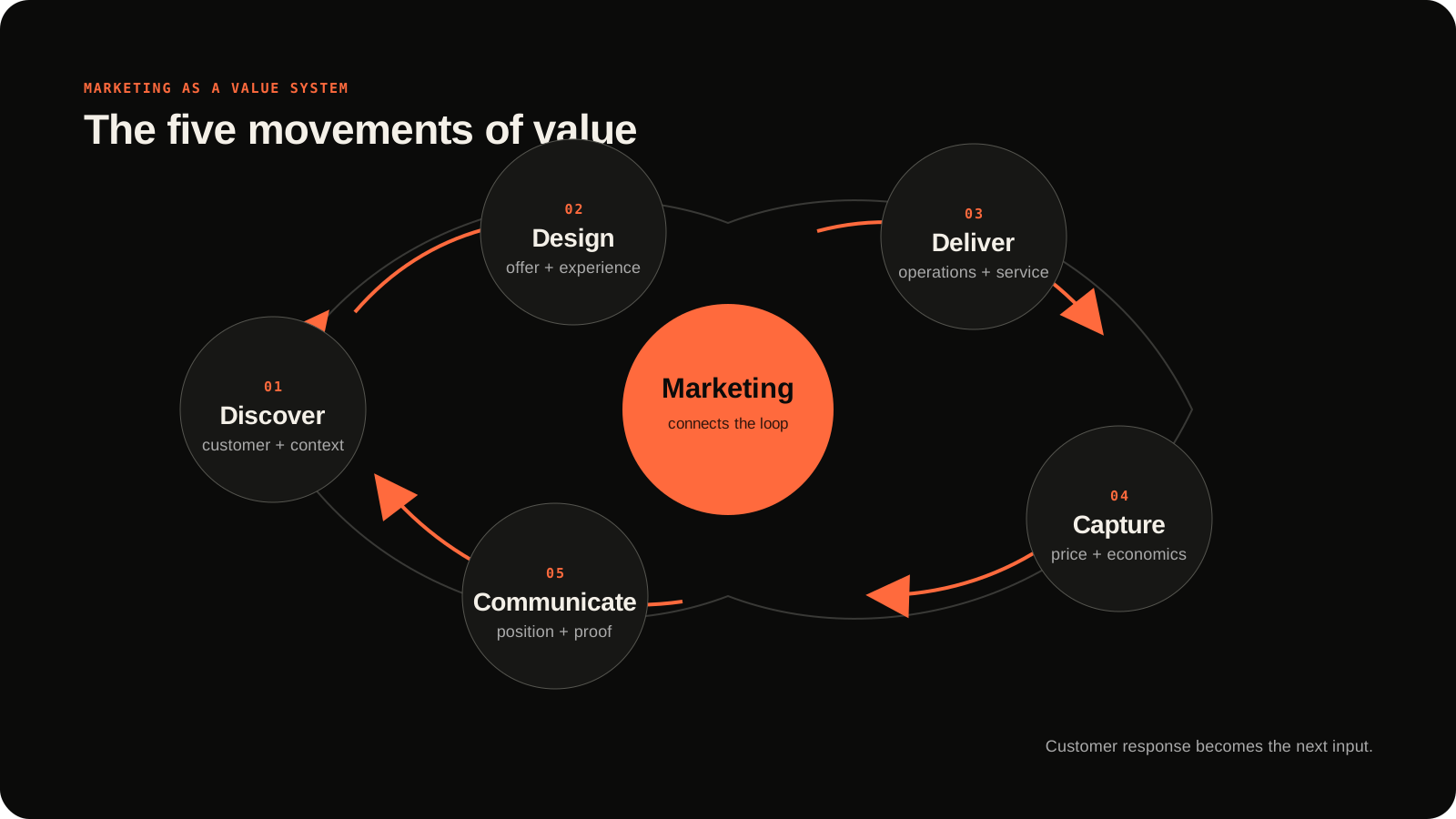
Marketing has a role in all five.
The communication layer is simply the most visible one.
Positioning sits across all five movements. It connects what the customer values, what the product delivers, what operations can support, what the economics allow and what the market can believe.
This is also why the “year outside marketing” should not be random. The goal is to visit the parts of the business that change how you understand those five movements.
I would start with seven rooms.
Room 1: Customer support, where brand strategy becomes extremely specific
Marketers spend significant amounts of money trying to discover the customer’s language.
Customer-support teams usually have it recorded.
Support hears where the promise becomes confusing, which policy feels unfair, which feature is misunderstood, what customers expected, and the exact sentence they use when the experience fails.
This is not merely a source of complaint themes. It is a live record of the difference between positioning and delivery.
Imagine a company promoting “effortless returns.”
The campaign performs well.
Inside the support queue:
Customer: I submitted the return eight days ago.
Agent: The request is still waiting for warehouse confirmation.
Customer: So which part is effortless?
Agent: The advertisement, possibly.
That conversation contains a better brand audit than a 70-slide presentation.
A marketer who spends time with support begins to see that customer experience is not a separate department. It is the operational proof of the brand.
Christine Moorman’s work on the marketing function argues that marketing creates value by connecting the customer not only to the product, but also to service delivery and financial accountability.6 Support is where those connections become visible in real language.
What marketers should learn there
- The gap between expected and delivered value
- Recurring objections and confusion
- The language customers use without prompting
- Where policies damage trust
- Which promises should not be amplified until operations improve
This changes marketing from “How do we describe the experience?” to “What experience are we currently entitled to describe?”
Room 2: Sales, where positioning has to survive a human conversation
Marketing often describes an audience at segment level.
Sales meets the person who says no.
Listening to sales calls teaches marketers where a value proposition becomes vague, which proof points matter, which competitor appears in the real decision, and what buyers are afraid of.
A sales objection is not always something communication should overcome. Sometimes it is product feedback. Sometimes it is a pricing problem. Sometimes it is a sign that the targeting is wrong.
The lazy response is:
“Sales needs better collateral.”
Sometimes sales does need better collateral.
Sometimes the collateral is being asked to perform minor surgery on the business model.
The point of spending time in sales is not to turn every marketer into a salesperson. It is to understand how the proposition behaves when somebody can interrupt it.
Advertising gets to finish the sentence.
Customers do not always allow that luxury.
Room 3: Product and design, where marketing should begin much earlier
Marketing should not merely launch products.
Marketing should influence what gets built.
That does not mean marketers should control product roadmaps. It means customer understanding, market context, positioning and adoption should enter the product conversation before development is complete.
When marketing joins too late, it inherits every unresolved compromise and is asked to convert it into enthusiasm.
Product: We built six features.
Marketing: Which customer problem do they solve?
Product: That is what we hoped the launch campaign would clarify.
The best product conversations force precision. It is the same discipline I explore in the six skills every AI product builder should develop:
- Who is this for?
- What changes for them?
- Which alternative are they replacing?
- What evidence would make the promise credible?
- What is deliberately excluded?
- What behaviour is required for the product to create value?
Quibi is a useful cautionary case. The mobile streaming service launched in April 2020, then its founders announced that they would wind down the company about six months later. Their own explanation pointed to two possibilities: the standalone idea was not strong enough, or the timing was wrong, and they suspected both.7 The case is more complicated than one marketing mistake; product design, viewing context, pricing, timing and market behaviour all mattered. That is precisely the point. A marketing campaign cannot rescue a value proposition that does not fit how people want to behave.
Strong marketers learn enough product thinking to recognize that difference before launch.
Room 4: Operations, where the brand promise has to become physically true
Operations is where brand adjectives acquire consequences.
Fast.
Fresh.
Easy.
Premium.
Personal.
Reliable.
Each word creates an operating requirement.
“Next-day delivery” is not copy. It is inventory accuracy, warehouse capacity, cut-off times, carrier performance, system integration, exception management and customer communication.
“Personalized service” is not a tone of voice. It is data, permissions, training, workflow and employee capacity.
“Always available” is a dangerous phrase to write when someone in operations knows exactly how often it is unavailable.
Marketers who learn operations begin asking better questions:
- What constraint limits the promise?
- What does demand generation do to capacity?
- Where does quality vary?
- Which customer journey crosses the most hand-offs?
- What happens after conversion?
- What is the cost of failure?
This is also where lean thinking becomes useful. Waste is not only excess inventory or process delay. From a customer perspective, waste can be repeated information, unnecessary steps, waiting, confusion and rework.
Marketing often has visibility into the customer problem. Operations understands the process producing it. The real opportunity sits between them.
Room 5: Finance and pricing, where enthusiasm meets arithmetic
I do not think every marketer should become an accountant.
I do think every marketer should understand enough finance to know when a campaign is creating value and when it is purchasing the appearance of success.
At minimum, marketers should be comfortable with:
- Revenue
- Gross margin
- Contribution margin
- Fixed and variable costs
- Customer-acquisition cost
- Retention and customer lifetime value
- Payback period
- Incrementality
- Opportunity cost
- Budget trade-offs
- Total cost of ownership for tools and platforms
Consider a discount campaign.
Sales increase by 30%.
The dashboard looks excellent.
But the discount reduced contribution margin, promoted low-margin products, increased fulfilment costs and attracted customers who did not return.
Was it successful?
The answer is not automatically no. The campaign may have cleared inventory, acquired valuable customers or supported another strategic objective.
But the answer cannot be derived from conversion alone.
Financial literacy helps marketing distinguish perceived value from captured value.
Marketing can increase perceived value through brand, design, experience, proof and positioning. The business captures value through price, margin, retention and an economically viable model.
The smartest marketers understand both sides. They look for ways to increase what the customer believes the offer is worth without blindly increasing the cost of delivering it.
That is not “selling harder.”
It is value design.
Room 6: Project management, because a campaign is already a project
This is one of the least glamorous recommendations, which is probably why it matters.
Most campaigns have:
- A defined objective
- A beginning and an end
- A budget
- Stakeholders
- Dependencies
- Risks
- Milestones
- Deliverables
- Approvals
- A launch date
That is a project.
Yet marketing culture sometimes treats project management as administrative support rather than a core professional skill.
The result is familiar.
Monday: The campaign is strategic.
Wednesday: The campaign is urgent.
Friday: The campaign is waiting for legal.
Next Monday: The launch date has not moved.
Project management gives creativity a better chance of surviving reality.
It teaches marketers to define scope, distinguish must-haves from nice-to-haves, identify dependencies, estimate honestly, manage stakeholders, document decisions and make trade-offs before the deadline makes them on everyone’s behalf.
It also improves trust.
When a marketer connects an estimate to a timeline and a list of assumptions, stakeholders can understand what is possible. When the marketer simply says “we are working on it,” everyone is free to invent their own expectation.
Project management is not the enemy of creative work.
Poorly managed work is.
Room 7: Data, technology and systems, where the campaign stops being a poster
Modern marketing depends on systems: customer data, CRM, analytics, content, commerce, experimentation, automation, advertising platforms, consent, product feeds and increasingly AI agents.
Marketers do not need to become engineers.
They do need to understand the shape of the system.
My simplest model is:
Input → Process → Output
For a campaign:
| Layer | Example |
|---|---|
| Input | Customer data, product information, creative assets, budget, offer rules |
| Process | Segmentation, approvals, automation, bidding, personalization, fulfilment |
| Output | Communication, conversion, customer experience, revenue, learning |
This model exposes a common mistake: obsessing over the output while ignoring poor inputs.
If product data is incomplete, personalization becomes confidently wrong.
If customer consent is unclear, targeting becomes risky.
If campaign taxonomy is inconsistent, reporting becomes a reconstruction exercise.
If the offer logic does not match the commerce system, the customer discovers the integration gap at checkout.
AI makes this even more important. Better prompts do not compensate for broken source data, missing context or an undefined approval process.
Marketers who understand systems stop treating technology as a collection of tools and start seeing the flow of information, decisions and value. They begin asking how the work becomes a decision system rather than another dashboard.
Room 8: General management and entrepreneurship, where trade-offs become unavoidable
I know I promised seven rooms.
Marketing added another one after the scope was approved.
That is also realistic.
General management teaches the skill every function believes it already has: making trade-offs across the whole business.
A marketer may want more budget.
Operations may need capacity.
Product may need development time.
Finance may need stronger cash flow.
Leadership has to decide which constraint matters most now.
Entrepreneurship provides the same lesson with less protection. In a small business, positioning, pricing, customer acquisition, fulfilment, cash, product and service recovery are not departments. They are Tuesday.
This perspective prevents marketers from optimizing their own metric at the expense of the system.
It also changes the question from:
“How can marketing get more resources?”
to:
“Where can the business create the highest-value customer and commercial outcome with the resources available?”
That is a much more senior question.
Domino’s did not market its way out of a product problem
One of the clearest examples of cross-functional marketing is Domino’s “Pizza Turnaround.”
In 2009, Domino’s publicly announced that it was changing its core pizza recipe. The company said the work followed extensive customer feedback and involved testing cheeses, sauces and crust blends over an extended development period. Its announcement explicitly described the involvement of product development, franchisees, supply-chain partners, leadership and marketing.8
The communication became powerful because the business had changed something worth communicating.
The campaign did not say:
“Our pizza is better because the new brand platform contains the word better.”
It acknowledged the criticism, changed the product and made the operational organization support the claim.
That is the difference between communication and marketing.
Communication told the story.
Marketing helped connect customer feedback, product change, operational delivery, pricing, proof and public perception.
So should marketers literally quit?
Not necessarily.
A title needs to do some work too.
But marketers should deliberately create the equivalent of a year outside marketing.
That could be a formal rotation, a cross-functional role, a startup experience, project ownership, recurring shadowing or a structured learning plan.
Here is one version.
| Quarter | Focus | Practical experience |
|---|---|---|
| Q1 | Customer reality | Shadow support, listen to sales calls, review complaints and returns |
| Q2 | Value design and delivery | Join product discovery, service design and operational process reviews |
| Q3 | Commercial judgment | Learn unit economics, pricing, margin, forecasting and ROI |
| Q4 | Execution and systems | Lead a cross-functional project, map data/process flows and own the post-launch review |
The point is not collecting vocabulary from other departments.
It is changing your judgment.
By the end of the year, a marketer should be able to answer:
- What customer problem are we solving?
- Why is this product or service meaningfully different?
- What must be operationally true for the promise to hold?
- How does the business capture value?
- Which metric represents real progress?
- What trade-offs are we making?
- What should we stop doing?
- How will we know whether the result was incremental?
- Which part of the customer journey is outside marketing’s direct control but inside marketing’s responsibility?
Positioning sits at the intersection
I still believe positioning is one of marketing’s core skills.
But positioning is not copywriting with better posture.
It is a strategic choice about:
- The customer
- The problem
- The category
- The alternative
- The value
- The proof
- The price
- The experience
- The promise the organization can repeatedly keep
That is why positioning belongs at the centre of customer insight, product, finance, operations, sales, service, systems and brand communication.
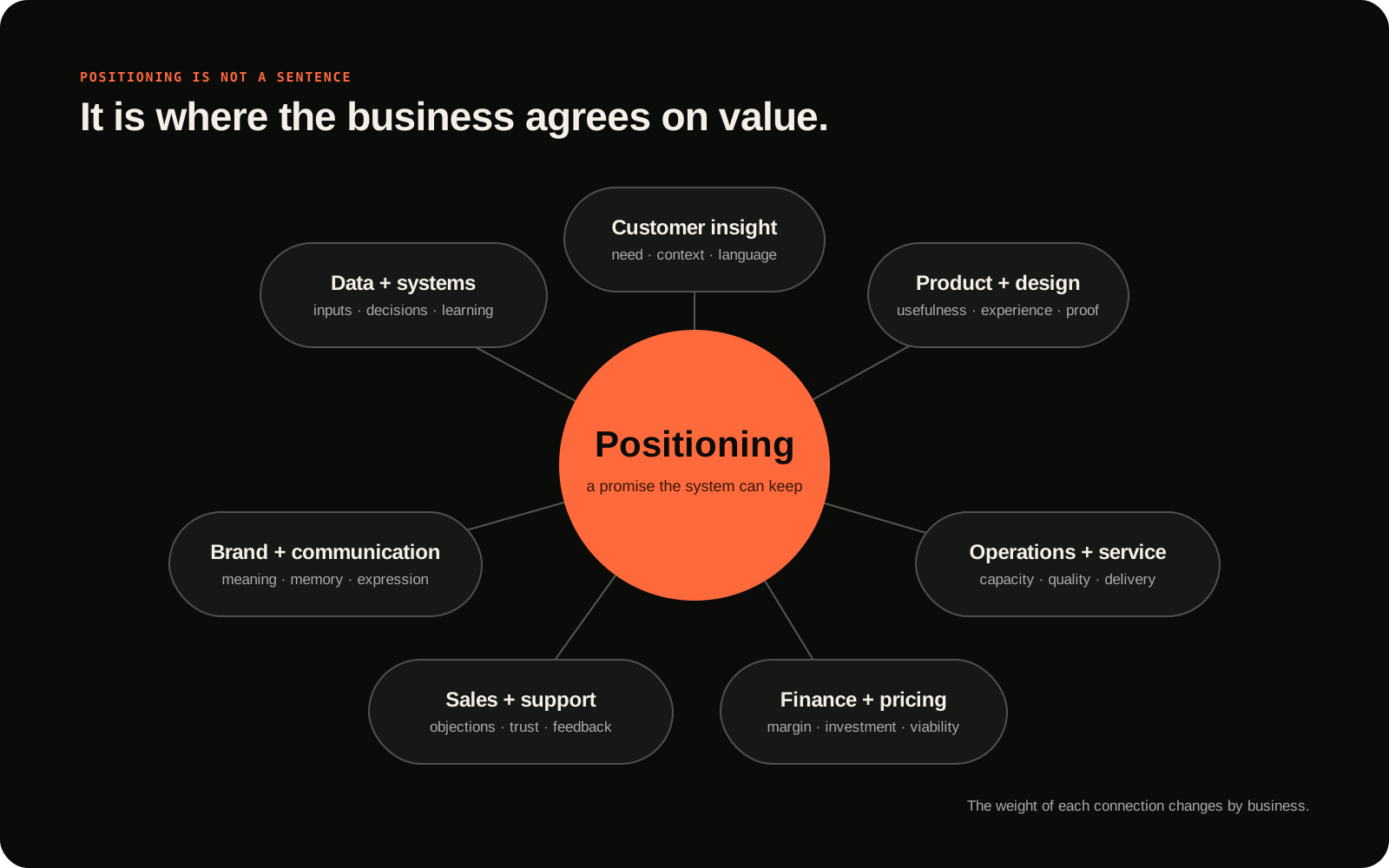
Some overlaps should be larger than others depending on the business.
Pricing and positioning may be inseparable in a luxury category.
Operations and positioning may overlap more in delivery, hospitality or retail.
Product and positioning dominate in software.
Customer support becomes central in services with high complexity or anxiety.
There is no universal diagram because the system changes.
The principle does not.
The strongest positioning is discovered at the intersection of what customers value, what the product does, what operations can deliver and what the business can sustain.
The marketers who leave the bubble come back more useful
The goal is not to make marketing less creative.
It is to give creativity something more substantial to work with.
A marketer who understands finance can make a stronger commercial case for brand investment.
A marketer who understands operations can avoid promises the business cannot keep.
A marketer who understands product can influence the offer before launch.
A marketer who understands project management can protect timelines, scope and quality.
A marketer who understands systems can see why the dashboard and the customer experience disagree.
A marketer who understands sales and support can use the customer’s actual language instead of inventing a more sophisticated version of it in a workshop.
The future marketer is not merely a specialist in communication. It is the same broader shift behind rethinking the growth system before optimising its engine.
Nor is the future marketer a shallow expert in every department.
The useful shape is closer to a broad generalist with one or two deep areas: somebody who can understand the entire value system and then apply real marketing depth where it matters.
So no, do not resign tomorrow because an article told you to.
But consider quitting the version of marketing that begins only after the product is finished, the price is set, operations are committed and the customer experience is already designed.
Leave that job for a year.
You may return to the same title.
You will not return as the same marketer.
Further reading
Footnotes
-
Gartner, Survey reveals 84% of marketers report high collaboration drag, 2024. ↩
-
McKinsey & Company, A makeover for your marketing operating model, 2024. ↩
-
American Marketing Association, The Skills Marketers Need in 2025 and Beyond. ↩
-
American Marketing Association, AMA Marketing Competency Model. ↩
-
The CMO Survey, Topline Report 2026. ↩
-
Christine Moorman, The CMO Survey, Why Have a Marketing Function if Your Company Is Market-Oriented?. ↩
-
Quibi, An open letter from Quibi, 2020. ↩
-
Domino’s Pizza, Celebrating 50th Year, Domino’s Pizza Gives Itself a Makeover, 2009. ↩