
For a long time, I was reluctant to pay for AI tools.
Twenty dollars here. Another subscription there. A more capable model, an automation tool, a research assistant. Each purchase looked like another expense for something I could technically do myself.
I treated every new subscription as a small personal insult. Apparently the software had failed to notice that I was perfectly capable of doing everything manually and complaining about having no time.
That last sentence was the trap.
I could do it myself.
I could spend an hour collecting sources before writing. I could compare twenty options manually. I could reformat the same information into a document, presentation and email. I could open a blank page every time, reconstruct the context and repeat work I had already solved once.
The question was never whether I could.
The better question was whether doing it myself was still the best use of my time, attention and energy.
Many people evaluate an AI subscription by asking, “Is this worth $20 a month?”
That is incomplete accounting.
The real calculation includes the hours it returns, the mental switching it removes, the work it helps you attempt and the quality of attention you can redirect elsewhere. A tool that saves four hours a month does not need to generate a new income stream to be valuable. It may give those hours back to focused work, exercise, reading, family, rest or simply thinking without rushing.
But there is a danger hiding inside the same logic.
Once we start treating every hour as something to optimize, we can accidentally outsource the very activities that make us capable, original and human.
The goal is not to become 100% efficient.
It is to become deliberate about where efficiency belongs.
AI can save time while leaving us busy because the reclaimed capacity rarely stays empty. We automate work that should have been deleted, fill every saved hour with more output, and sometimes create a new job called “checking what the AI did.” The tool may be fast. The system around it is still perfectly capable of wasting an afternoon.
Start with the awkward question: what is your time worth?
Entrepreneur Dan Martell popularized a calculation he calls the buyback rate. One version begins by dividing annual income by roughly 2,000 working hours, then dividing the result by four. The final number becomes a threshold: if a recurring task can be delegated for less than that amount per hour, consider buying back the time.
For example, someone earning $100,000 annually has an effective hourly rate of approximately $50. Dividing that by four gives a buyback rate of $12.50. Under this model, paying someone $10 per hour to remove repetitive administrative work may create enough room for higher-value work while maintaining a margin of safety.
The exact number is only a heuristic. Income is not produced evenly by every hour, and a salaried employee cannot automatically convert a saved hour into another paid hour. The model is still useful because it exposes a habit many of us share: protecting small amounts of money by spending large amounts of life.
We compare the subscription with our bank balance.
We rarely compare it with the cost of remaining overloaded.
Suppose a $20 AI subscription saves you 30 minutes on four tasks each week. That is roughly eight hours per month. The tool is effectively returning time at $2.50 per hour.
That does not automatically make it a good purchase. The time saved must be real, the output must be useful and the tool must fit into your workflow. Paying for software you barely use is not leverage. It is a recurring donation to a dashboard.
But the right comparison is no longer “free versus $20.”
It is:
What does this cost, what capacity does it return, and what will I deliberately do with that capacity?
That final question matters. Buying back an hour and losing it to scrolling is not the same as reclaiming it.
AI can carry the boxes. You still choose where they go.
We often use the word thinking as though it were one activity.
It is not.
Thinking includes remembering, searching, sorting, comparing, calculating, generating, interpreting, challenging and deciding. These tasks do not deserve the same level of protection.
Researchers use the term cognitive offloading to describe moving mental work into an external aid. A notebook offloads memory. A calendar offloads intention. A calculator offloads arithmetic. A process map offloads the need to hold an entire workflow inside your head. AI can offload parts of research, synthesis, drafting and pattern recognition.
This is not new, and it is not automatically intellectual decline. A review of intention offloading found external reminders to be highly effective, while also showing that people differ in how accurately they judge when offloading will help. The question is not whether we should use external intelligence. Human progress has always depended on it.
The question is which layer of cognition we are moving outside ourselves.
Consider these two uses of AI:
“Summarize these twelve meeting notes, identify repeated actions and put them into a table.”
“Tell me what I should believe about this issue and write my opinion for me.”
Both save effort. They do not outsource the same thing.
One clears the desk. The other quietly sits in your chair.
The first removes retrieval and organization. The second may remove the encounter with uncertainty from which judgment develops.
This distinction explains the mixed evidence around AI. In a preregistered experiment with 453 college-educated professionals, access to ChatGPT reduced completion time by 40% and increased assessed output quality by 18% on bounded professional writing tasks. A separate field study of 5,179 customer-support agents found an average productivity increase of 14%, with larger gains among novice and lower-skilled workers.
Yet research on AI-supported work also warns about overreliance, automation bias and reduced critical engagement. These findings should not be stretched into the claim that using AI inevitably makes people think less. They point to a conditional risk: when the system supplies the conclusion and the person becomes a passive approver, a better immediate output can coexist with weaker independent reasoning.
The practical rule is simple:
Outsource the cognitive load around the decision before you outsource ownership of the decision.
Let AI retrieve the evidence, structure the alternatives, expose contradictions, calculate scenarios and challenge your first answer.
Keep responsibility for what matters, what is true enough to act on and which trade-off you are willing to accept.
Some slow things are doing exactly what they are supposed to
I like drawing process maps.
AI can generate a diagram faster. In many situations, I want it to. But there are days when I deliberately take a notebook and draw the system myself.
The drawing is not merely a slower way of producing a diagram.
It is how I notice the system.
The friction forces me to decide where the process starts, which steps belong together, where information is lost and which exception I have been ignoring. If I outsource the map too early, I may receive a cleaner artifact while losing the thinking that the artifact was meant to provoke.
Reading can work the same way.
AI can summarize a Substack article in seconds. Sometimes that is precisely what I need. If I am screening twenty sources, summaries help me decide which three deserve attention.
But deliberate reading has a different purpose. I am not only collecting the author’s conclusions. I am spending time inside the construction of the argument. I notice the hesitation, the evidence, the voice and the idea that connects unexpectedly with something else I have been thinking about.
A summary transfers information.
Reading can transform understanding.
Quality time is an even clearer boundary. Dinner with someone I care about is not a task whose duration should be minimized. A walk without a productivity objective is not idle capacity. Making something by hand can be valuable partly because it takes time.
This leads to a principle that conventional productivity advice often misses:
Sometimes slowness is not the cost of the experience. Slowness is part of the experience.
Efficiency is valuable when time is an input cost. It can be destructive when time is the medium through which value is created.
Before you automate your life, decide what should remain yours
Before handing work to AI, automation or another person, evaluate it across five dimensions.
| Dimension | Question | If high | If low |
|---|---|---|---|
| Repeatability | Does this follow a recurring and describable pattern? | Automate or delegate | Keep human involvement |
| Learning value | Does doing this build a capability I want to retain? | Do it yourself or use AI as a coach | Offload more freely |
| Consequence | Would a plausible error cause material harm? | Require evidence and human approval | Allow greater autonomy |
| Meaning | Is the experience itself valuable to me? | Protect the process, not only the outcome | Optimize for speed |
| Recoverability | Can a poor output be detected and reversed cheaply? | Experiment with delegation | Add strict guardrails or retain control |
These dimensions produce four useful modes.
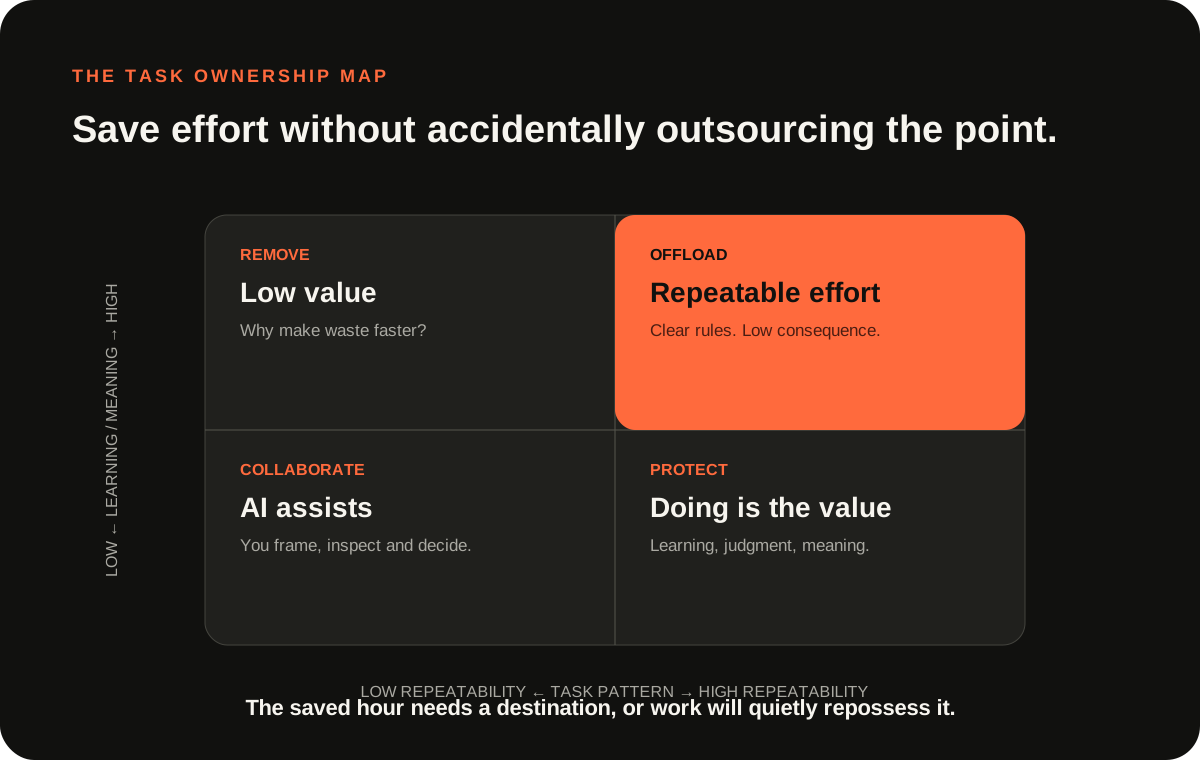
1. Remove
Some work should not be delegated or automated. It should stop.
Before buying a tool to accelerate a weekly report, ask whether anyone uses the report. Before automating a meeting, ask whether the meeting needs to exist. Before asking AI to write ten social posts, ask whether publishing ten posts serves the objective.
This is the first systems-thinking connection: optimizing a wasteful step makes the waste move faster.
Examples: duplicate reporting, low-value meetings, notifications without an owner, content produced only to satisfy a calendar.
2. Offload
These tasks are repetitive, low-risk, reversible and contain little learning or personal meaning.
Examples: formatting notes, transcribing audio, cleaning a spreadsheet, renaming files, scheduling, extracting actions, converting content into predefined formats.
This is where AI subscriptions and simple automation often produce the cleanest return.
3. Collaborate
These tasks benefit from AI capability but still require your context and judgment.
Examples: researching an unfamiliar market, preparing a first draft, comparing strategic options, analysing customer feedback, designing a process, pressure-testing a proposal.
The best pattern is not prompt → accept. It is:
Frame → generate → inspect → challenge → decide.
AI can carry the boxes. It should not quietly move into the chair where judgment is supposed to sit.
This is closely related to my argument in Stop asking AI one giant question. Design the decision graph. Complex work becomes safer when research, challenge, synthesis and approval are visible rather than hidden inside one polished response.
4. Protect
These are activities where doing is inseparable from becoming.
Examples: developing your point of view, learning a foundational skill, making a consequential ethical decision, spending quality time, reading something deeply, creating for pleasure, having a difficult human conversation.
AI may support the edges. It can suggest questions before the conversation or help you reflect afterward. It should not replace the encounter itself.
Please write the outsourcing contract nobody writes
Once you decide to offload work, do not simply throw it over a wall.
Delegation fails when we transfer a vague task but keep an invisible expectation.
A reliable outsourcing contract contains seven elements:
| Element | What to define |
|---|---|
| Outcome | What useful result should exist? |
| Input | Which information and sources may be used? |
| Boundary | What must the person or system not do? |
| Standard | What does acceptable quality look like? |
| Authority | Can it draft, recommend, approve or execute? |
| Check | Who verifies the output, and against what? |
| Feedback | How will corrections improve the next cycle? |
This contract works whether the executor is a colleague, freelancer, automation or AI agent.
It also links to a broader point I made in Does this workflow need an assistant, automation, or agent?: choose the smallest level of autonomy that can work reliably. A prompt may be enough for a one-off draft. Automation suits stable rules. An agent becomes useful when the system must select among actions, but more autonomy creates more requirements for boundaries, observation and recovery.
The goal is not maximum delegation.
It is dependable delegation.
Congratulations, you saved an hour. Now what?
This is the part most productivity systems treat as an administrative detail. It is actually the entire point. If the reclaimed hour has no destination, the surrounding system will absorb it and send a polite calendar invitation.
You do not need a complicated productivity system to apply this.
For one week, record tasks that consume more than fifteen minutes. Do not attempt perfect time tracking. Capture enough to see the pattern.
Then label each task:
| Label | Meaning | Next action |
|---|---|---|
| Delete | The outcome is not valuable | Stop it |
| Delegate | Another person can own it | Write the outsourcing contract |
| Automate | Stable rules and repeat volume | Build the smallest reliable workflow |
| Assist | AI can reduce load while you retain judgment | Define the human checkpoint |
| Develop | The effort builds a capability you need | Practise it deliberately |
| Enjoy | The process itself gives life value | Protect it from optimization |
Now calculate the financial case where it applies:
Effective hourly rate = annual income ÷ approximate annual working hours
Buyback rate = effective hourly rate ÷ 4
Then add two questions the financial formula cannot answer:
If I stop doing this, which capability might weaken?
If I accelerate this, which part of the experience might disappear?
This turns a productivity exercise into a life-design exercise.
A task may be financially sensible to outsource but strategically important to learn. A founder should not personally reconcile every invoice forever, but understanding the economics of the business may be essential. A manager can ask AI to draft employee feedback, but should not allow efficiency to remove the care, context and accountability from delivering it.
The framework does not produce one universal answer. That is the point.
A task can disappear and still create more work
Systems thinking is often described as seeing connections rather than isolated events. Outsourcing applies the same principle to work.
When one task leaves your hands, what happens next?
Does the saved time move to higher-value work, or does another bottleneck absorb it? Does automation reduce errors, or reproduce one error at scale? Does AI increase output, or create more material for you to review? Does delegation create ownership, or add another coordination layer?
The unit of analysis cannot be the task alone.
It has to be the loop:
Capacity → allocation → output → review → learning → improved capacity
This is why the best use of AI is not asking it to do more things. It is redesigning how work, attention and judgment move through the system.
The same idea appears in A decision system beats another dashboard. Information creates value only when it connects to rules, judgment and action. Outsourcing follows the same logic. A faster output without a clear decision or owner is merely faster activity.
What I am finally willing to pay for
I am becoming more willing to pay for tools that return genuine capacity.
Not because every new AI product deserves a subscription. Most do not. Not because my time is too valuable for ordinary work. Some ordinary work keeps me grounded. And not because I want to live at maximum speed.
I am willing to pay when the exchange is clear:
- Remove work that repeats without teaching me.
- Reduce administrative friction around work that matters.
- Expand the number of useful experiments I can run.
- Preserve my attention for judgment, relationships and creation.
- Give me time I can consciously return to life.
The aspiration is not to outsource everything below an hourly number.
It is to stop spending human attention as though it were free.
That may be one of the defining skills of working with AI: knowing when to ask the machine to carry the load, when to keep your hands on the decision, and when to put every tool away because the slow version is the version you actually want.
Do not outsource yourself in the pursuit of buying yourself more time.
Buy back the effort.
Keep the life.
Further reading
-
Dan Martell, How to Buy Back Your Time and Boost Business Profits.
-
Sam Gilbert and colleagues, Outsourcing Memory to External Tools: A Review of Intention Offloading.
-
Erik Brynjolfsson, Danielle Li and Lindsey Raymond, Generative AI at Work.
-
C. Zhai and colleagues, The Effects of Over-Reliance on AI Dialogue Systems on Students’ Cognitive Abilities.