
It has never been easier to look intelligent.
We can ask AI to explain a complex subject, turn the explanation into an opinion, package the opinion into a LinkedIn post and give us a confident response to anyone who disagrees.
The only optional step appears to be thinking about it.
Within minutes, we can have the language of someone who has spent years thinking about the subject.
But there is an uncomfortable question underneath the quality of the output:
Did I think this, or did I simply recognize a well-written thought when I saw one?
That distinction is becoming harder to see.
AI does not only help us express what we think. It can suggest what deserves attention, frame the alternatives, select the evidence, supply the conclusion and imitate the tone in which a thoughtful person might deliver it.
The result may be accurate and useful. It may also feel like our own reasoning because it arrived inside our conversation, used our vocabulary and responded to our instructions.
This is why one of the most important skills in the AI era is not prompting.
It is metacognition: the ability to observe, evaluate and regulate your own thinking.
Sounding intelligent has never been cheaper
The title of this article asks whether the thought is actually yours.
The honest answer is that polished language cannot tell you.
Intelligence is a broad and contested construct involving abilities such as reasoning, learning, problem solving and adapting to unfamiliar situations. Metacognition is related but different. It concerns what you understand about your own cognition and how effectively you monitor and control it.
You can be highly capable and poorly calibrated.
You can produce a sophisticated argument without noticing that you began with the conclusion. You can remember information quickly while misunderstanding the underlying idea. You can speak confidently because the material feels familiar, even though you could not reconstruct it without assistance.
Research on self-regulated learning consistently shows that people often hold inaccurate beliefs about how well they understand and remember. Fluency can create an illusion of learning: when something is easy to read or sounds familiar, we may mistake ease of processing for mastery.
Metacognition interrupts that illusion.
An intelligent person may be able to defend an idea.
A metacognitive person also asks:
- Why did this idea become convincing to me?
- Which evidence would make me change it?
- Am I explaining the truth, or defending my identity?
- Do I understand this, or do I merely recognize the language?
- How confident should I be, given the quality of the evidence?
Metacognition does not guarantee better judgment. It gives judgment a feedback loop.
That is why I would treat it not as proof of intelligence, but as an intelligence multiplier.
“Thinking about thinking” sounds academic. It is actually quality control.
The phrase thinking about your own thinking can sound philosophical and vague.
In practice, metacognition has three parts:
| Function | The question | Example |
|---|---|---|
| Knowledge | What do I know about myself, this task and useful strategies? | I tend to accept a polished first answer when I am tired. |
| Monitoring | What is happening in my thinking right now? | I understand the examples but cannot explain the principle. |
| Control | What should I change based on what I noticed? | I will close the source, explain it from memory and check the gaps. |
This creates a simple loop:
Plan → Think → Observe → Adjust → Review
Without the observation and adjustment stages, we can repeat the same mental habits while interpreting effort as progress.
We read more but do not test whether we understood.
We collect more information but do not identify what would change the decision.
We prompt AI repeatedly but never inspect why the first result felt wrong.
We publish consistently but slowly inherit the structure, opinions and voice of everyone else publishing consistently.
Metacognition makes the hidden process available for redesign.
That is systems thinking applied inward.
AI can widen your thinking and quietly build the walls
AI is often described as either a threat to thought or an amplifier of thought.
Both descriptions are too simple.
My reading of the current studies is that the effect depends heavily on how the person distributes cognitive responsibility between themselves and the system.
A 2025 survey of 319 knowledge workers found that greater confidence in generative AI was associated with less reported critical-thinking effort, while greater confidence in one’s own ability was associated with more. The researchers also observed that critical thinking shifted toward verifying information, integrating responses and supervising the task. Because the study relies on self-reported examples, it identifies an association rather than proving AI caused a loss of critical-thinking ability.
That is potentially valuable. We do not have to perform every cognitive operation manually to remain thoughtful.
But supervision works only when the supervisor can evaluate the work.
Promoting yourself to supervisor after outsourcing the expertise is, unfortunately, not a complete governance model.
If I ask AI about a subject I barely understand, I may lack the mental model required to recognize a subtle error. Worse, fluency can disguise the gap. The answer is structured, balanced and specific. My feeling of understanding rises faster than my actual ability to explain or apply it.
Recent research has used terms such as cognitive offloading, metacognitive disengagement and epistemic confinement to describe versions of this problem. The last term is especially useful: we can feel as though we are exploring a subject while staying entirely inside the boundaries the AI constructed for us.
The model chose the frame.
We explored the frame.
Then we mistook movement inside it for independent thought.
A polished answer can improve the output before it improves the person evaluating the output.
AI becomes more useful when we deliberately recover ownership of the frame.
Before asking for the answer, define the question.
Before requesting options, state which criteria matter.
Before accepting the synthesis, ask what was excluded.
Before publishing the argument, identify which part came from your experience, which part came from evidence and which part came from the model.
Welcome to the age of polished sameness
This problem extends beyond prompts and productivity.
It is entering culture.
Open any content platform and you will find the same architecture appearing repeatedly:
- A provocative opening that announces a hidden truth
- A personal confession engineered into a lesson
- Three to seven clean principles
- A false contrast between what “most people” do and what successful people do
- A final sentence designed to be highlighted and reposted
None of these structures is inherently bad. Clear writing often needs structure.
The problem begins when the structure starts producing the thought.
We see what performs, imitate it and gradually train ourselves to experience life in content-ready units. AI makes that imitation faster. Give a model a collection of popular posts and it can reproduce their rhythm without needing the years of experience that originally gave some of them substance.
There is emerging evidence that this can reduce diversity at scale. In three preregistered studies analysing 2,200 college-admissions essays, researchers found that additional human essays contributed more new ideas than additional GPT-generated essays. Another controlled experiment with 118 participants from India and the United States found that AI writing suggestions shifted Indian participants toward Western writing patterns, reducing some culturally distinctive expression.
These studies do not prove that every AI-assisted article becomes generic. They reveal a pressure toward convergence.
The more we begin from the same models, study the same viral examples and optimize for the same platforms, the easier it becomes to produce individually polished but collectively similar work.
Metacognition is how we notice that influence before it becomes identity.
Ask:
Is this my clearest expression, or merely the expression I have been trained to recognize as good?
Going with the flow still counts as choosing a direction
We often imagine conformity as a deliberate choice made by weak-minded people.
Usually, it is less dramatic.
We borrow the priorities of our environment because attention is limited. We use social proof because evaluating everything independently would be exhausting. We adopt professional language because it helps us belong. We repeat an opinion because several intelligent people expressed it confidently before we had time to investigate.
These shortcuts are not automatically irrational. No one can rebuild all knowledge from first principles.
Intellectual independence does not mean refusing influence.
It means becoming more aware of how influence enters your thinking.
This is particularly important for people who consume large amounts of content. A varied information diet can expand perspective, but constant consumption can also prevent ideas from becoming internally organized. The next interpretation arrives before we have formed our own.
Eventually, we become well-informed about what everyone is saying and uncertain about what we think.
The solution is not to stop learning from other people.
It is to create a gap between input and adoption.
A practical framework for not borrowing your own opinion
Use this loop for important decisions, unfamiliar subjects and AI-assisted creation.
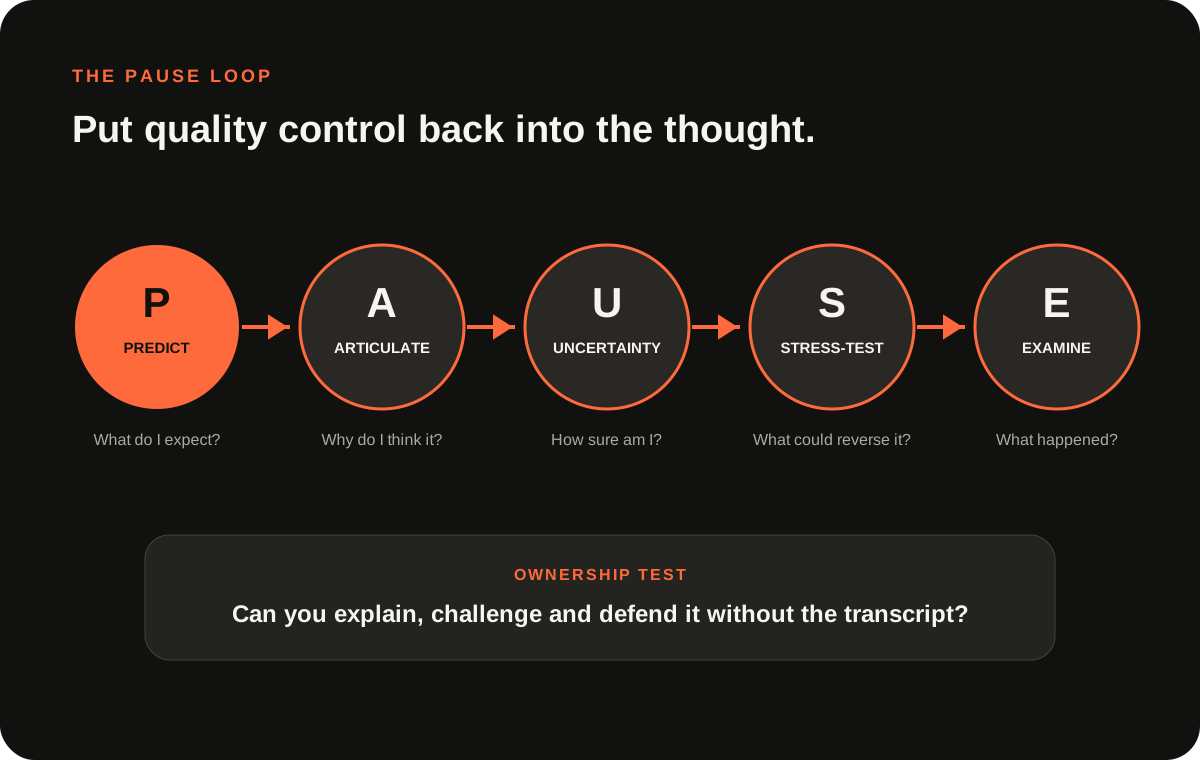
P: Predict before receiving
Before searching or prompting, write what you currently believe will be true.
This can be one sentence:
I expect customer complaints to be driven mainly by delivery delays, although I have not checked the data.
Prediction exposes your starting model. Without it, new information can overwrite the past so smoothly that you forget what you originally misunderstood.
For content, begin with your raw point before asking AI to develop it. An imperfect paragraph gives the tool something genuinely yours to preserve and challenge.
A: Articulate the reasoning
Do not record only the conclusion. Show the path.
- What evidence am I using?
- Which assumption connects the evidence to the conclusion?
- Which alternative explanation did I consider?
- What value or objective influences the decision?
If you cannot articulate the path, confidence in the destination should fall.
U: Uncertainty calibration
Assign a confidence level before seeing the outcome: 55%, 70%, 90%.
The number is not scientific precision. It creates a record that can later be compared with reality. Over time, you can notice whether your 90% judgments are usually correct or whether confidence has become part of your communication style rather than a reflection of evidence.
Also separate different uncertainties. You may be highly confident that a customer problem exists but uncertain that your proposed solution will change the behaviour.
S: Stress-test the frame
Ask AI to challenge rather than merely complete your reasoning:
- What am I assuming without evidence?
- What is the strongest alternative explanation?
- Which stakeholder would see this differently?
- What evidence would reverse the recommendation?
- Have I framed this as a binary choice when other options exist?
This connects with my argument in Stop asking AI one giant question. Design the decision graph. Important decisions deserve separate stages for investigation, contradiction and human judgment.
E: Examine the outcome
After the result, do not ask only whether you were right.
Ask why.
A good outcome can follow bad reasoning. A bad outcome can follow a reasonable decision under uncertainty. If we learn only from results, luck can teach us the wrong lesson.
Review:
- What did I predict?
- What actually happened?
- Which assumption held or failed?
- Which signal did I miss?
- What will I do differently next time?
The loop turns experience into a model update rather than another story about success or failure.
Eleven ways to catch yourself outsourcing the thought
Eleven sounds suspiciously like a list produced by someone avoiding a round number. Still, each catches a different failure mode, and combining them into “think harder” would be much less useful.
1. Think before you prompt
Write your initial answer, criteria or hypothesis first. Even sixty seconds helps preserve your starting point.
2. Use AI as a mirror, not only a generator
Give it your reasoning and ask it to identify assumptions, contradictions and missing perspectives. This retains more cognitive ownership than requesting a finished position from nothing.
3. Keep a decision journal
For meaningful decisions, record the context, options, expectation, confidence and reasons. Review the entry when the outcome becomes visible.
4. Practise retrieval instead of recognition
After reading or watching something, close it and explain the idea from memory. Recognition says, “This looks familiar.” Retrieval shows what is actually available to you.
5. Explain it without the vocabulary
If you understand an idea, you should usually be able to express it in simpler language and produce a new example. Borrowed jargon can hide an incomplete model.
6. Separate evidence, interpretation and decision
Use three columns:
| Evidence | Interpretation | Decision |
|---|---|---|
| What was observed or sourced? | What might it mean? | What will we do, given our objective and risk? |
This prevents an interpretation from quietly reappearing as a fact.
7. Track the origin of important ideas
When writing, label raw notes as personal observation, external research, another person’s idea or AI suggestion. You do not need to publish the labels. Their purpose is to preserve intellectual provenance while developing the work.
8. Create before you consume
If you are developing an opinion or article, spend ten minutes writing before opening the feed. Otherwise, the most recent confident voice may become the starting architecture of your own.
9. Schedule deliberate friction
Draw the process map yourself. Read the full essay. Calculate one example manually. Have the conversation without a script. As I argued in If AI saves you time, why are you still so busy?, some effort is waste, while some effort is where capability and meaning are formed.
10. Ask for disconfirming evidence
Do not tell AI only to make the case stronger. Ask what would make the case weaker and require credible sources. Agreement improves an argument’s appearance. Resistance can improve its structure.
11. Run the ownership test
After using AI, close the conversation and ask:
- Can I explain the conclusion in my own words?
- Can I state the strongest objection?
- Do I know which evidence carries the most weight?
- Can I identify what I remain uncertain about?
- Would I defend this decision without access to the transcript?
If not, you may own the output without yet owning the thought.
Reflection should end in a decision. Eventually.
There is a bad version of thinking about thinking.
It becomes rumination: inspecting every thought, distrusting every instinct and delaying action until uncertainty disappears.
That is not the goal.
Effective metacognition regulates effort. It helps you decide when to think more and when the decision is good enough to act on. Some choices are reversible and deserve speed. Others are consequential and deserve investigation. The same person should be capable of both.
This is where metacognition meets systems thinking. You do not add maximum scrutiny everywhere. You place feedback, checks and human judgment where failure matters and learning is valuable.
The purpose of reflection is better action.
Not permanent hesitation.
When everyone sounds smart, what is intelligence worth?
Soon, polished language will tell us very little about the depth of thought behind it.
Almost everyone will be able to generate plans, strategies, explanations, images and opinions that look competent at first glance. Content will multiply. Advice will become cheaper. Confidence will be available on demand.
The scarce capability will be knowing what deserves to be trusted.
That requires more than evaluating AI.
It requires evaluating ourselves.
Where did this belief come from?
Why am I certain?
Which part did I understand?
Which part did I inherit?
What would change my mind?
And what kind of thinker am I becoming through the tools and content I repeatedly use?
Perhaps the best sign of intelligence is not always having an answer.
Perhaps it is noticing what your mind is doing while the answer is being formed, and retaining the freedom to form it differently.
Further reading
-
John Dunlosky and Janet Metcalfe, Metacognition, for the foundational distinction between monitoring and control.
-
Robert Bjork, John Dunlosky and Nate Kornell, Self-Regulated Learning: Beliefs, Techniques, and Illusions.
-
OECD, The Triangle of Lifelong Learning.
-
Hao-Ping Lee and colleagues, The Impact of Generative AI on Critical Thinking.
-
Shreya Singh and Soo Young Rieh, Enhancing Critical Thinking in Generative AI Search with Metacognitive Prompts.
-
Kibum Moon and colleagues, Homogenizing Effect of Large Language Models on Creative Diversity.