
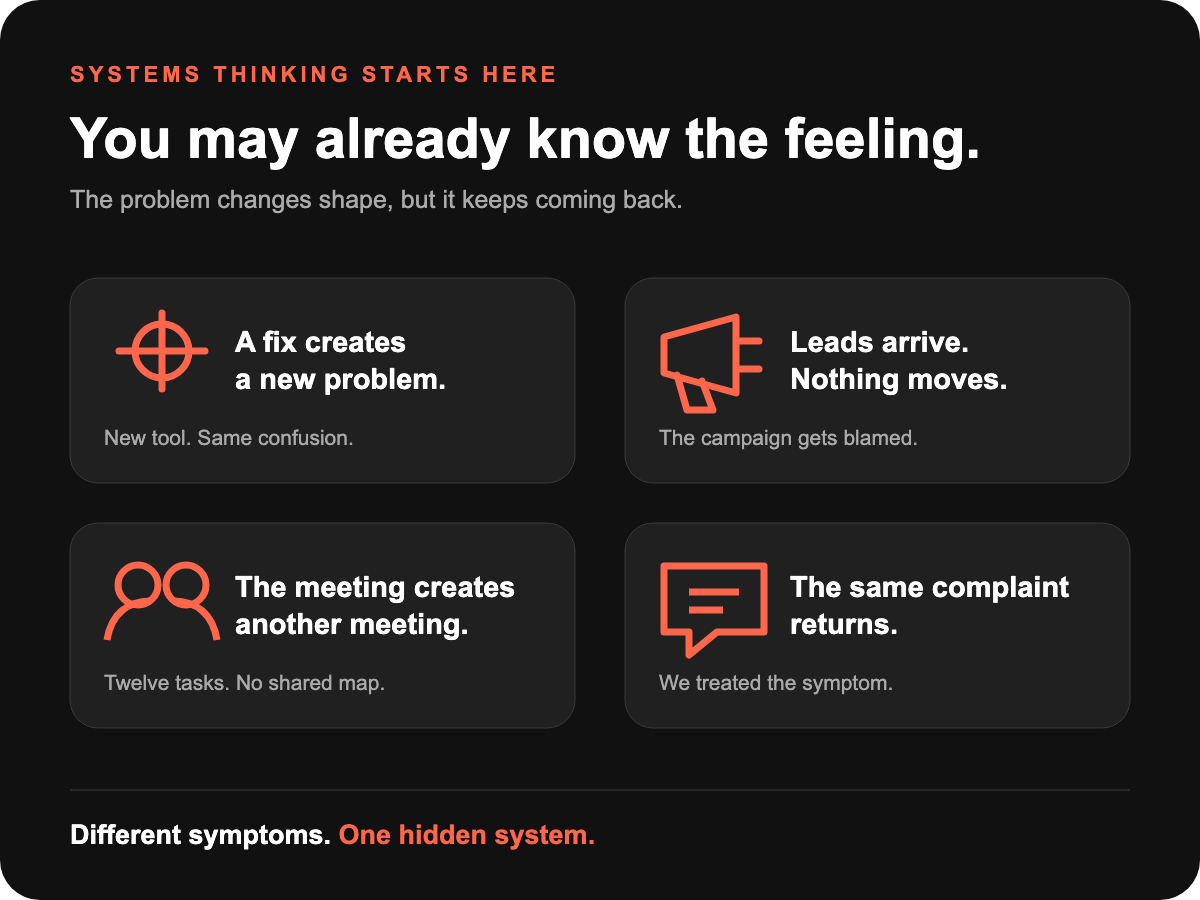
Have you ever fixed a problem only to watch it reappear somewhere else?
You introduce new software to make work faster. Now the work is faster, but nobody knows which version is correct.
You launch a campaign to generate more leads. The leads arrive. Sales cannot follow up, operations cannot deliver the promise, and marketing is asked to generate even more leads. Naturally.
You leave a meeting with twelve action points, six owners and a strong sense that another meeting will be required to understand the first one.
These situations look different, but they share the same problem: we are looking at the pieces while missing how the pieces affect one another.
That is systems thinking.
You do not need to know the term to have experienced its absence. In fact, I think systems thinking may be one of the most important skills nobody properly taught us. We are taught to finish our task, improve our department and solve the problem in front of us. We are rarely taught to ask:
“If I change this, what else changes?”
That simple question can save a great deal of time, money and workplace theatre.
Connecting the dots is a skill
Some people naturally notice connections.
They hear a customer complaint and wonder whether the issue began in the sales promise. They see a delayed project and ask whether the real problem is approval, not effort. They look at a weak campaign and question the product experience before changing the advertisement.
This can be irritating when everyone else would like to discuss the colour of the button and go home.
But connecting dots is not a distraction. It becomes a distraction only when every dot feels equally important and none of them is turned into a decision.
The useful skill has two parts:
- See how things connect.
- Slow down enough to decide what to do about it.
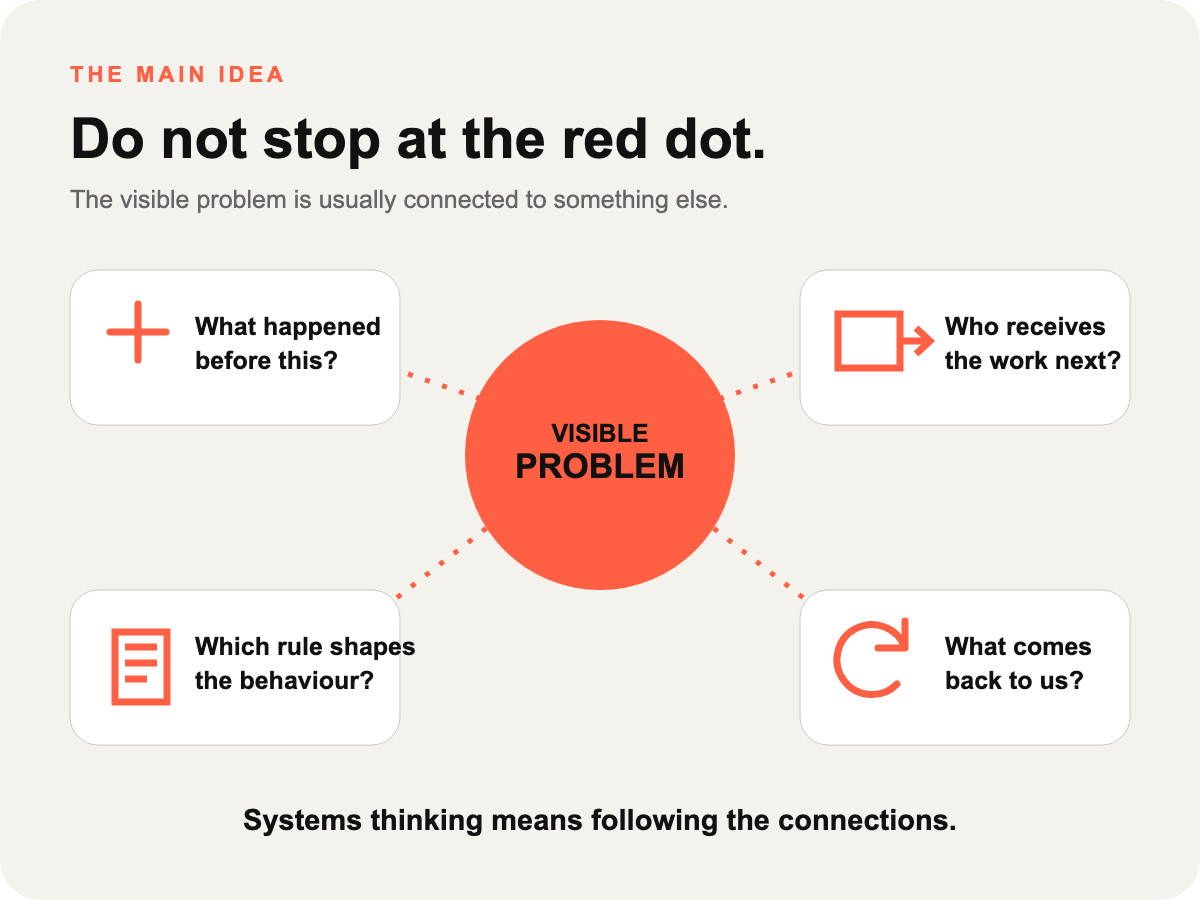
This is what researchers mean when they describe systems thinking as paying attention to relationships, interactions and dependencies, rather than studying each part alone (WHO, NASA).
The important word is relationships.
A product can be good while the handoff is bad. A team can be capable while the incentives are wrong. A tool can work perfectly while the process around it makes no sense.
If you only inspect the visible failure, you may fix the symptom and preserve the machine producing it.
Why this matters now
Work is becoming more connected. A marketing decision can affect operations. A product choice can change customer support. An AI tool can alter who makes a decision, what gets reviewed and who is responsible when the answer is wrong.
That is why employers expect systems thinking to become more useful toward 2030 (World Economic Forum). You do not need to become a systems engineer. You need to become better at seeing beyond the edge of your own task.
Consider something as ordinary as introducing an AI assistant.
The easy question is:
“Which AI tool should we buy?”
The systems questions are:
- What work are people actually trying to complete?
- Where do they lose time or information?
- What context does the AI need?
- Which decisions should remain human?
- Who checks the result?
- Where will the learning be documented?
The tool is one box. The outcome comes from the connections around it.
ADHD can help, if I remember to use the brakes
ADHD is relevant to my experience, but it is not the subject of this article.
My brain can open six workstreams before a meeting has finished defining the first one. I might be listening to a product discussion while connecting it to pricing, customer behaviour, operations and the awkward email someone will eventually have to send.
That can be useful. It can also look like this:
“I have found seven connected problems.”
“Excellent. Which one are we solving?”
“…yes.”
The superpower is not simply having more thoughts or moving faster. It is recognising patterns, then developing enough self-awareness to pause, choose a boundary and explain the connection to somebody else.
If you have ADHD, that may feel familiar. If you do not, the lesson still applies: a quick mind is useful; a mind that can change speed is more useful.
We understand more when we can see the relationship
I believe most people understand a system more easily when they can see it.
Think about how you learned to use a smartphone. You did not begin with a forty-page explanation of information architecture. You saw an icon, touched it and observed what happened. The screen showed relationships between choices and outcomes.
This is not an argument for labelling every person a particular “learning style.” Research does not support teaching people differently merely because they call themselves visual or auditory learners (review). The simpler point is practical: when the subject is a relationship, drawing the relationship helps.
Words arrive one after another. A visual lets us inspect several things together.
That is why a rough process map can be more useful than a polished twenty-page document. The moment the work leaves your head and appears on a page, other people can point at the missing step, question the assumption and improve the model.
You do not need specialist software. Boxes and arrows are enough. If the arrows reveal something uncomfortable, the drawing is working.
A practical example: the campaign that “did not work”
Imagine a company launches a campaign for a new service.
After one month, sales are disappointing. The immediate conclusion is familiar:
“Marketing needs to improve the campaign.”
Perhaps. But before changing the creative, let us look at the system.
1. Pause
Replace the conclusion with a question:
Where are potential customers losing confidence?
This prevents the team from treating “low sales” as proof that the advertisement is the problem.
2. Map
Draw the path:
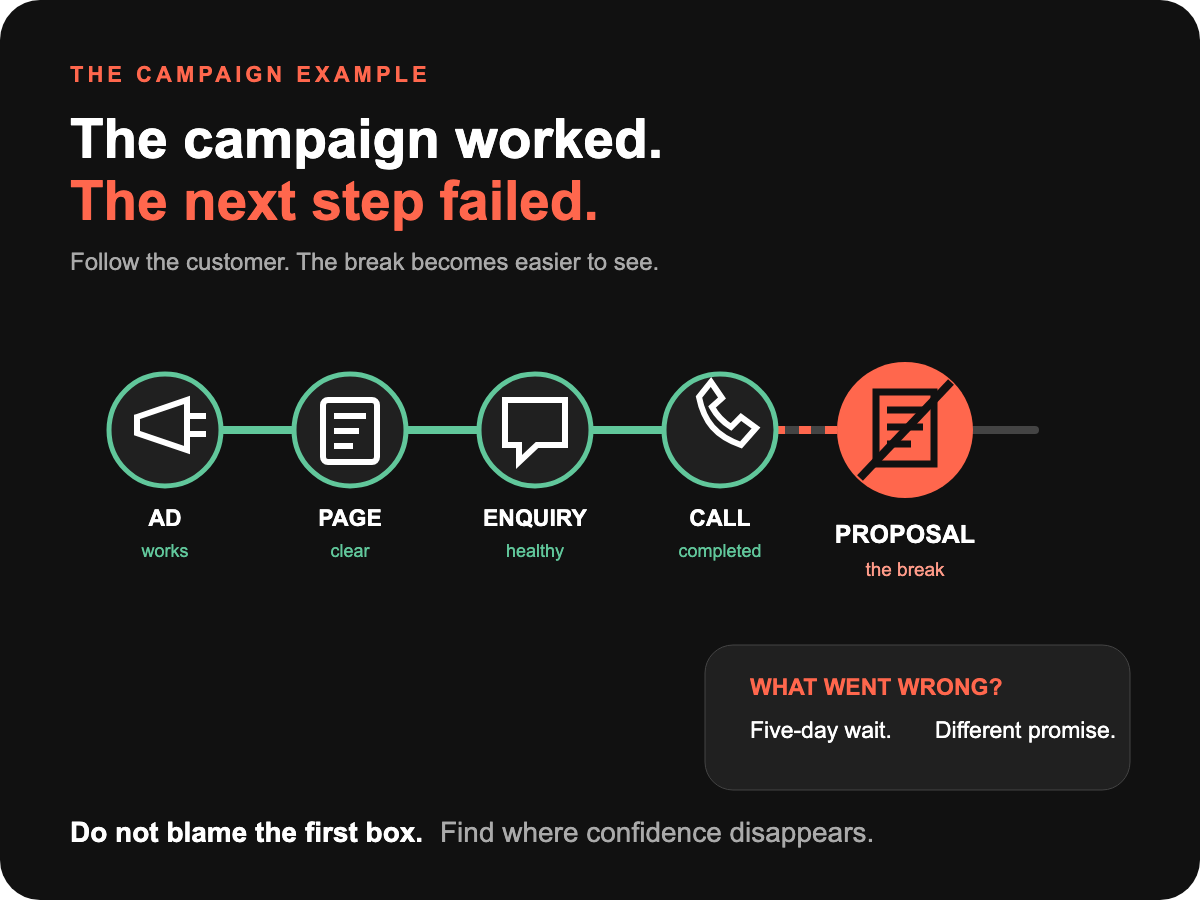
Audience → advertisement → landing page → enquiry → sales call → proposal → delivery
Now add what each stage needs from the one before it. The landing page needs a clear promise. Sales needs the right customer information. Delivery needs the promise to be realistic.
The team discovers that enquiries are healthy. People are disappearing after the sales call because the proposal takes five days and describes a different service from the advertisement.
The campaign did work. The system after the campaign did not.
3. Bound
Do not attempt to redesign the entire company by Friday.
Choose the part that matters now: the handoff from enquiry to proposal. Give it an owner, a target and a clear beginning and end.
4. Document
Write down the promise, customer information required, proposal rules, owner and expected response time.
This is not paperwork for the sake of paperwork. It means the process no longer depends on one person remembering how everything works. People can find the answer without waiting for the colleague who is on leave, in a meeting or pretending not to see the message.
The same documentation also gives AI useful context. Instead of asking, “Write a proposal,” you can provide the service promise, customer need, constraints, approved language and review criteria. I explore that principle further in Stop asking AI one giant question.
5. Review
After the change, check whether proposals are faster, clearer and more likely to convert.
If nothing changes, update the map. Your first explanation was wrong. This is not failure; this is the system giving you feedback.
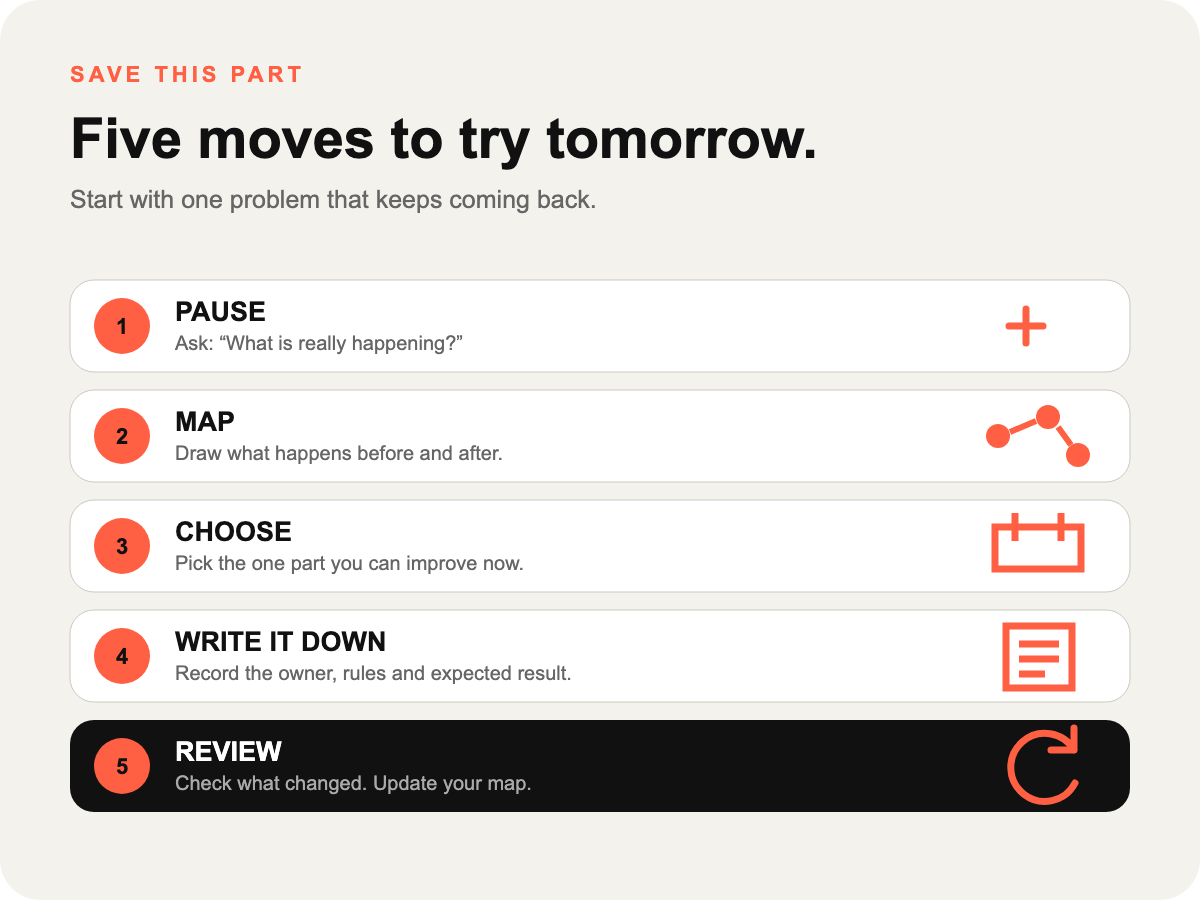
This small example contains the entire discipline:
Pause → Map → Bound → Document → Review
It works for a campaign, a customer complaint, a delayed project, a hiring process or an AI workflow.
Documentation turns thinking into leverage
A system that exists only in one person’s head is not really an organisational system. It is a dependency with a calendar.
Documentation allows memory to move. It helps somebody else understand why a decision was made, what should happen next and what to do when the normal path fails. Companies designed around people working at different times treat documentation as essential because otherwise everyone must wait for the person who knows the answer (example).
This is also why documentation matters for AI.
AI can help with a task. It cannot magically know your unwritten standards, customer history, political sensitivities or definition of “good.” The more clearly you document the system, the more safely you can delegate parts of it to people or machines.
The prompt is not the system.
The context, rules, ownership and review around the prompt are the system.
How to practise systems thinking tomorrow
You do not need a qualification or a complicated diagram. Start with one recurring frustration.
Ask:
- What keeps happening?
- What happens immediately before it?
- Who or what does the work pass through?
- What information is missing at each handoff?
- What behaviour are the current rules rewarding?
- If I change this part, what else might change?
Then draw it.
Show the map to somebody involved in another part of the work. They will probably see a connection you missed. That is not a threat to the model. It is the purpose of the model.
Systems thinking is learnable because it is not magic. It is a habit of looking beyond the event, making relationships visible and testing whether your explanation matches reality.
Some people may naturally connect dots faster. Others may be better at testing, organising or finishing. The goal is not to become the person who sees everything.
The goal is to help people see enough of the same thing to make a better decision together.
The skill is not seeing more. It is making more sense.
We will keep adding new technology to work. We will keep creating specialist roles. We will keep asking people to move faster.
That makes systems thinking more important, because somebody still needs to notice how the parts affect one another.
Connecting the dots is not the problem. Keeping every connection inside your head is.
Slow down. Draw the relationships. Choose the part you can change. Document what matters. Watch what happens next.
You may discover that the problem everyone has been trying to solve is not the problem at all.