
Imagine the first Monday after your career ends.
The money is fine. You planned for that. There is no alarm, no commute and no urgent message waiting for a reply. For years, this was supposed to feel like freedom.
Then somebody asks a very normal question:
“So, what do you do?”
For most of your adult life, the answer came from work. Your job gave you more than income. It gave you a title, a calendar, a group of people who knew what you were good at and a reason to feel useful before 9 a.m.
When the job goes, what else goes with it?
The question reveals how much of our life has been designed to depend on work.
In my previous article, I argued that systems thinking may be the most important skill we never learned. We usually apply that idea to businesses, products and processes. But a life is also a system. It has several connected parts: work, money, health, relationships, community, curiosity and contribution.
The danger begins when one part is quietly asked to support almost everything else.
We prepare for the financial exit, not the human one
Most retirement advice starts with a number. How much have you saved? What will your expenses be? At what age can you stop working?
Those questions matter. Financial insecurity can overwhelm every more philosophical conversation about purpose. But money answers only one part of the transition.
I am now midway through reading the HBR Guide to Designing Your Retirement, and I realised how closely its ideas connect with systems thinking. The book asks you to look beyond the financial event and consider the wider life around it: experiment with possible future selves, find new ways to use old skills and bridge your existing identity into whatever comes next (HBR).
The accompanying toolkit even includes an exercise for building a personal board of directors (HBR toolkit).
My interpretation is simple: retirement becomes harder when work becomes the structure holding the rest of your life together.
If your closest relationships, strongest source of confidence, daily routine and sense of contribution all come from the same place, leaving work can bring several losses on the same day.
A career should be one important part of your identity, not the entire structure supporting it.
Build an identity portfolio
We understand financial concentration risk quite easily. If every investment is tied to one company and that company struggles, the whole portfolio struggles.
We are less careful with identity.
Someone asks what we do and we answer with an employer, industry or title. That is convenient and may be accurate. It becomes risky when the answer feels complete.
“I lead transformation” can quietly become “I am valuable because I lead transformation here.”
A reorganisation, redundancy, health issue or retirement can change both the work and the person’s explanation of who they are.
An identity portfolio gives that weight to several pillars instead:
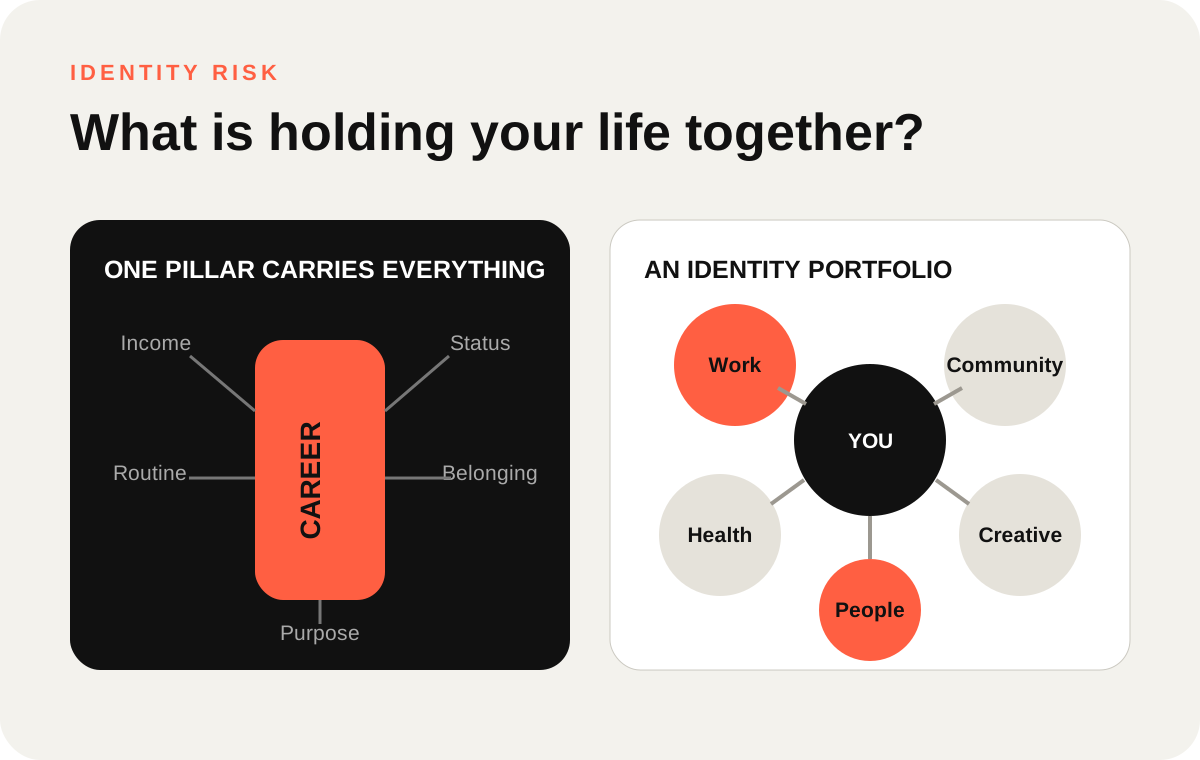
For me, those pillars might include professional leadership, building products, writing, speaking, community, health, friendships and family. The balance will never be equal, but each one needs to exist outside a future plan called “one day.”
Research gives the identity portfolio some useful support. Across three studies of adults aged 49 to 75, people with more group memberships tended to anticipate and experience more positive identity changes in retirement. The authors are careful about what the studies can prove, but the pattern is useful: belonging to more than one meaningful group can give identity more than one place to live (Current Psychology).
You can test this long before retirement. Ask yourself:
- If my current job disappeared tomorrow, which parts of me would remain active?
- Who would still ask for my help?
- Where would I still belong?
- What would still make an ordinary Tuesday meaningful?
If every answer leads back to work, too much of your identity may be concentrated in one place.
Your experience does not retire when your title does
There is another mistake hidden in the usual picture of retirement. We imagine only two settings:
Working or stopped working.
Real life has more range than that.
A project leader can become an adviser. A marketer can teach smaller organisations how to understand customers. A technical specialist can mentor. A senior operator can help a social enterprise avoid ten expensive mistakes. Someone who spent years building teams may find that the most satisfying work is no longer managing a large department, but helping a few people grow.
The skill remains. The form changes.
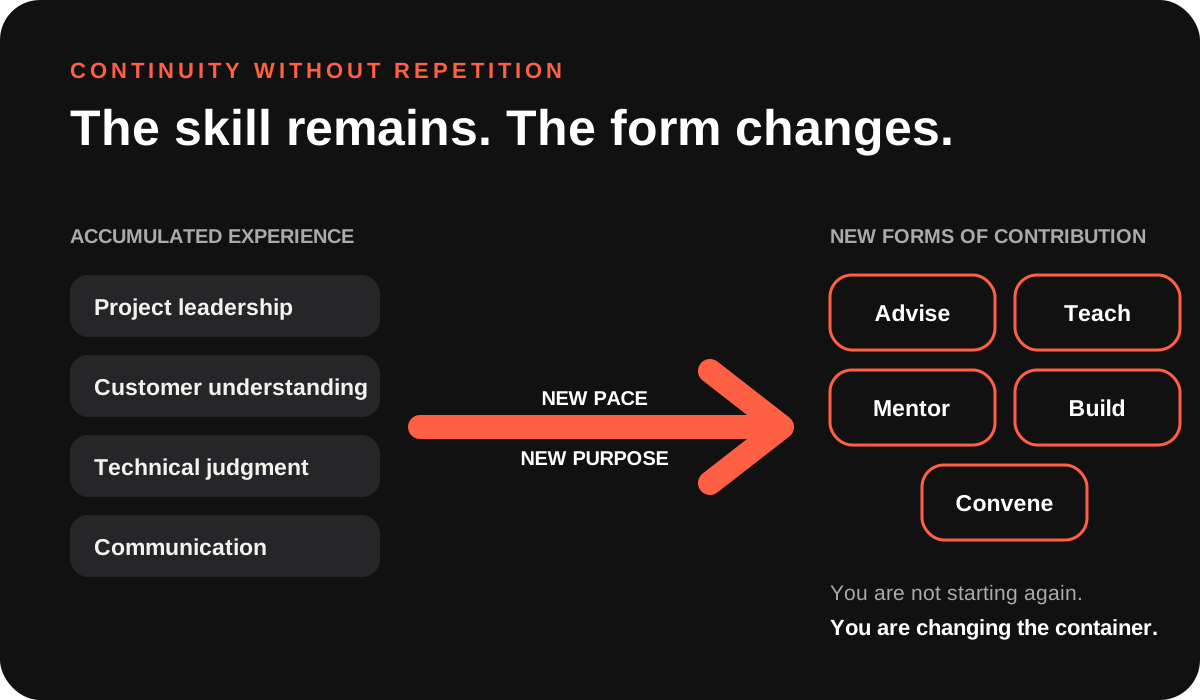
Retirement can give you more choice over the form, pace and purpose of your contribution.
Research uses the rather mechanical phrase “bridge employment” for paid work between a main career and complete withdrawal from work. The definitions vary, and not everybody has equal freedom to choose this path. But the wider finding is useful: later-life work can take several forms, and accumulated experience influences which transitions become possible (Innovation in Aging).
I suspect many people still want to be useful, with more choice over the conditions under which they contribute.
That is a different design problem.
Instead of asking, “What job will I do after this job?” try asking:
“What value have I learned to create, and what other forms could that value take?”
The answer may include paid work. Advising, teaching, mentoring, writing, volunteering, building and convening people can all carry experience forward too.
The aim is to separate your ability to contribute from one organisation’s way of using it, without manufacturing a busy retirement so you can continue complaining about your calendar.
Prototype the next version before you need it
We would never recommend launching an important product without testing it. Yet people sometimes plan the next thirty years of life entirely inside a spreadsheet.
The spreadsheet can tell you whether the idea is affordable. It cannot tell you whether you will enjoy living it.
If you think you might enjoy teaching, teach one small session now. If advising sounds attractive, help one founder with a real problem. If you imagine writing, publish something before buying the beautiful notebook. If community matters, organise one gathering and see whether you enjoy the work required to make it meaningful.
Small experiments reveal information that imagination cannot:
- Does this activity give me energy or only look impressive from a distance?
- Do I enjoy the practice, or merely the identity attached to it?
- Does anybody find it useful?
- What skills or relationships would make it sustainable?
This is where the article connects back to systems thinking. You are not trying to predict one perfect future. You are creating feedback.
Possible self → small experiment → lived evidence → better decision
Your future becomes something you learn about, not something you announce at age sixty-five and hope works.
Build a personal board of directors
Major life decisions are usually made by a committee of one, meeting internally at inconvenient hours.
This committee has several weaknesses. It shares the same assumptions, remembers the same evidence and becomes unusually persuasive after midnight.
A personal board of directors is a small group of people who help you see different parts of the system. They can advise you separately and informally; the value comes from the different judgment each person brings.
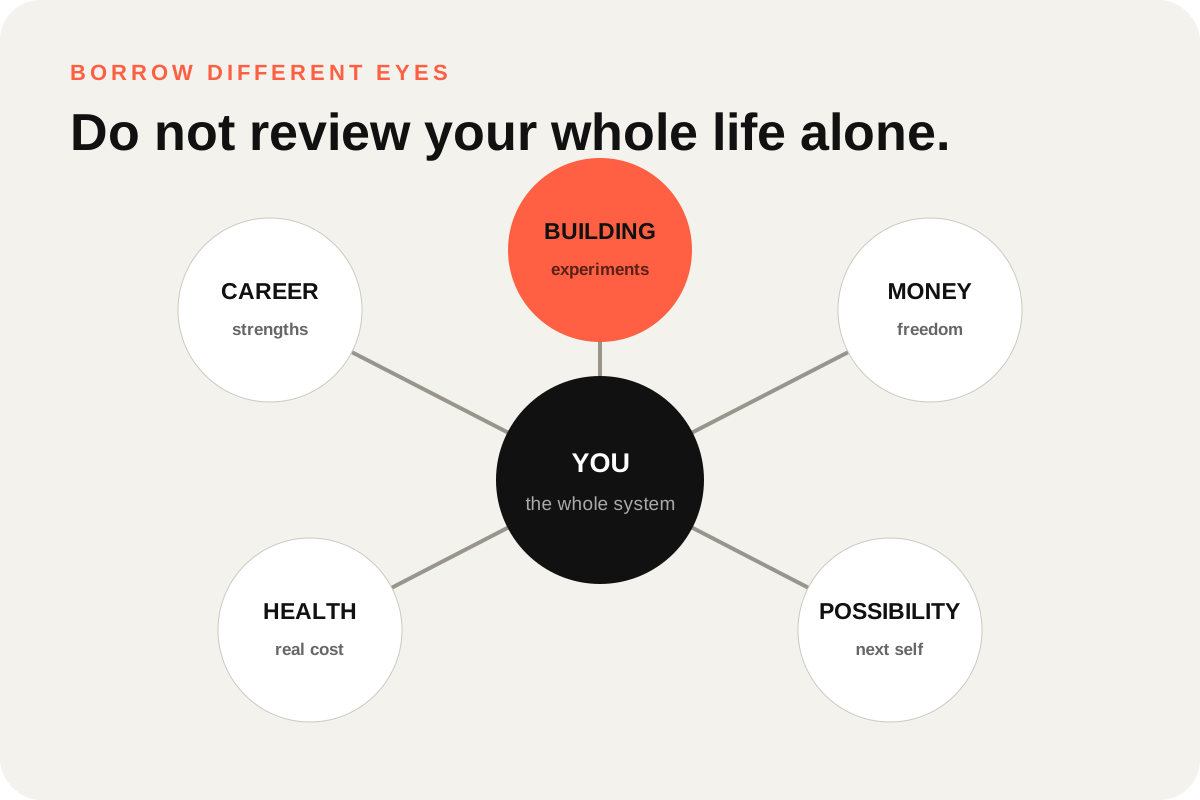
Your board might include:
| Perspective | What this person helps you see |
|---|---|
| Career | Which strengths are becoming more valuable |
| Building | Which idea is worth testing in the real world |
| Money | What freedom is financially realistic |
| Health and relationships | What ambition is costing outside work |
| Possibility | Which version of you is trying to emerge |
Choose people who will challenge different blind spots, not five people who admire the same plan.
The financially disciplined person may ask whether the dream is sustainable. The entrepreneur may ask why you are waiting. The person who knows your health may point out that a plan requiring constant exhaustion is not freedom with better branding.
This also changes how you use relationships. You are no longer asking one partner, friend or mentor to be the sole reviewer of every decision. Different people can help with different parts.
A five-step life-system review
Start with a review of the system you already have rather than trying to create a perfect forty-year plan.
1. Pause: what is work currently providing?
List everything your job gives you beyond salary: status, structure, learning, friendship, challenge, belonging, visibility and contribution.
Do not judge the list. Make the invisible dependencies visible.
2. Map: where else could those needs be met?
Which relationships exist outside work? Where do you learn without being assigned a course? Who benefits from your skills without appearing on your organisation chart?
You may discover that money has alternatives in a financial plan, but belonging has none.
3. Choose: strengthen one weak pillar
Do not redesign your identity by next quarter.
Choose one neglected area. Join a community. Restart a creative practice. Protect a weekly health commitment. Mentor one person. Build one small product. The action should be real enough to teach you something.
4. Document: make the future specific
Write down the version of life you are testing:
I want more of…
I want less of…
I still want to contribute through…
The relationships I want to protect are…
The experiment I will run for the next three months is…
Vague aspiration feels pleasant. Specific language makes a decision possible.
5. Review: what gave you energy, meaning and evidence?
After the experiment, ask what actually happened. Did you enjoy the work? Did it strengthen a relationship? Did somebody find it useful? Would you still want it if nobody called it impressive?
Then adjust the map.
That is the discipline: Pause → Map → Choose → Document → Review. The same moves that help us understand a business system can help us design a life system.
Do not wait for retirement to become more than your job
Meaningful work can be a source of pride, growth, friendship and genuine contribution. It becomes fragile when we ask it to carry everything.
Retirement simply makes the dependency easier to see. But the same system is tested by redundancy, burnout, relocation, illness, parenthood, entrepreneurship or the quiet realisation that the title you worked toward no longer feels like enough.
Financial planning asks whether you can afford to stop.
Life design asks what will still make you want to start the day.
Build that answer before you need it. Let your career remain important, but give your identity more than one pillar, your experience more than one form and your future more than one possible path.
Carry your usefulness beyond any one job, so your identity never depends on that job to prove your value.