
I was scrolling through Instagram when I noticed that almost everything seemed to come from one of two places.
Someone was having the best week of their life, or explaining how they survived the worst one.
Apparently, nobody had simply had an okay Tuesday.
There were holidays, promotions, engagements, transformations and carefully lit evidence that life was going well. Then there were confessions, heartbreaks, burnout, betrayal and stories about reaching the lowest point before rebuilding everything.
Both sides can be real. Both deserve to be shared.
But I started wondering what happened to everything in between.
Where are the ordinary days that were neither wonderful nor terrible? The periods when we are grateful and dissatisfied at the same time? The thoughts we have not finished developing? The quiet changes that matter to us but do not contain a dramatic lesson?
Human life is mostly lived in that middle.
The feed makes it increasingly difficult to see.
Maybe we are not binary thinkers. Maybe we are binary posters.
It is tempting to conclude that social media has turned all of us into binary thinkers.
Psychologists use terms such as dichotomous thinking or black-and-white thinking to describe the tendency to place complex realities into opposing categories:
- Success or failure
- Good or bad
- Victim or villain
- Productive or lazy
- Pro-AI or anti-AI
- Living your best life or falling apart
The pattern is easy to scan because every item arrives with its opposite already attached. Real life is less considerate.
| Feed-friendly category | What ordinary life often sounds like |
|---|---|
| Success or failure | Progress, with trade-offs I am still understanding |
| Productive or lazy | Tired, distracted, recovering or focused on something else |
| Pro-AI or anti-AI | Useful here, risky there and still changing quickly |
| Thriving or falling apart | Mostly okay, occasionally brilliant, sometimes a mess before coffee |
That is related to what I noticed, but it is not exactly the same.
Seeing a feed filled with emotional extremes does not prove that people themselves have lost the ability to think in shades. A feed is a selected and ranked representation of life, not life itself. It is shaped by what people choose to post, what audiences respond to and what platforms decide to distribute.
The more defensible argument is this:
We have not necessarily become binary thinkers. We increasingly communicate through systems that make binary expression easier to produce, understand and reward.
Our inner lives may still contain ambiguity. Our public expression is being compressed into recognizable forms.
The middle is not boring. It is where most of life happens.
The middle of life is not feeling nothing.
It is often feeling several things at once.
You can be proud of a promotion and unsure whether you want the life attached to it. You can love someone and still need distance. You can be optimistic about AI and worried about what it does to work, creativity and human judgment. You can be happy overall and have a difficult week.
These are not contradictions that need to be resolved immediately. They are normal examples of emotional and intellectual complexity.
The middle also contains experiences that are meaningful without being momentous:
- A conversation that changed one small assumption
- A quiet weekend that did not become a memory reel
- Partial progress on something difficult
- Advice that depends on context
- An opinion that contains both agreement and disagreement
- A question that is still more valuable than its current answer
I first called these “general aspects.” A better description may be ordinary life, everyday reflection, mixed experience or simply the uneventful middle.
The word uneventful can sound dismissive. But some of the most important parts of life are uneventful from the outside. Trust develops gradually. Understanding accumulates. Identity changes before an announcement can be made about it.
The event is visible.
The becoming usually is not.
Why normal life is terrible content
In a private conversation, you can mention something small because the conversation already exists.
On social media, pressing “post” feels like making an announcement.
That creates an unconscious test:
Is this important, attractive, painful, surprising or useful enough to interrupt other people?
A promotion passes the test. A breakup passes it. A holiday passes it. “I had a moderately satisfying afternoon and changed my mind slightly about something” usually does not.
There is no obvious reaction button for “That sounds quietly significant. Please continue when you understand it better.”
This is partly a problem of social legibility. Other people must be able to understand quickly what kind of post they are seeing and how they are expected to respond.
Celebrate this.
Feel sorry about this.
Be angry about this.
Learn this lesson.
Choose this side.
Ambivalence asks more from the audience. It requires context, patience and sometimes the willingness to leave the thought unresolved.
The feed is rarely designed for unresolved thoughts.
Happiness can be packaged. So can suffering.
Social media is a communication channel, archive, marketplace and stage at the same time.
Research on online self-presentation describes a well-established norm of presenting positive, idealized and socially desirable versions of ourselves. This does not mean every positive post is false. Selecting a beautiful part of a real life is still selection.
But sadness can also become a recognizable performance.
There is the vulnerable confession, the recovery narrative and the story of the lowest point that eventually produces a lesson. These may be sincere. The format simply makes pain easier to communicate once it can be shaped into a clear arc.
This is why the issue is not “happy content is fake and sad content is honest.”
Both happiness and suffering can be packaged into stories.
The least publishable reality is often:
I am okay, but not completely. Something is changing, but I do not yet know what it means.
That statement may be emotionally true and algorithmically useless.
Your boss, aunt and best friend walked into the same audience
Researchers use the term context collapse to describe what happens when separate audiences are combined into one.
Your family, colleagues, old classmates, manager, close friends and strangers may all encounter the same post. Each knows a different version of you and interprets your words through a different relationship.
It is the communication equivalent of giving a speech at a wedding where your manager, mother and someone you argued with in 2014 are seated at the same table.
In person, we naturally adjust context. We do not explain a difficult career decision to a close friend in the same way we announce it professionally. Social platforms can flatten those boundaries.
When you do not know exactly whom you are addressing, nuance becomes risky.
A half-formed opinion may be treated as a permanent position. An exploration may be interpreted as advocacy. A personal reflection may worry your family, confuse a colleague or invite advice from somebody who knows nothing about the situation.
People adapt by sharing content that is difficult to misunderstand:
- A clear achievement
- A beautiful experience
- A definitive position
- An identifiable hardship
- Advice broad enough to apply to everyone and therefore fully to no one
Nuance needs context.
Context is exactly what the feed removes.
Platforms can measure reaction. Understanding is less cooperative.
A social platform can measure whether you stopped, watched, liked, saved, shared or commented.
It cannot easily measure whether an ordinary sentence quietly changed how you understood your own life.
Research comparing engagement-based ranking with chronological feeds found that engagement optimization can amplify more divisive content even when it does not improve reported satisfaction. Related work found that moral-emotional language spread more widely within political networks, although the effect varied by emotion and group boundaries.
This does not establish that every algorithm rewards the same emotion or that platforms created human attraction to drama. Humans noticed threat, conflict and emotionally important events long before the internet.
The system is better understood as a feedback loop:
People react to emotional clarity → platforms amplify measurable reactions → creators notice what travels → more content is designed for reaction
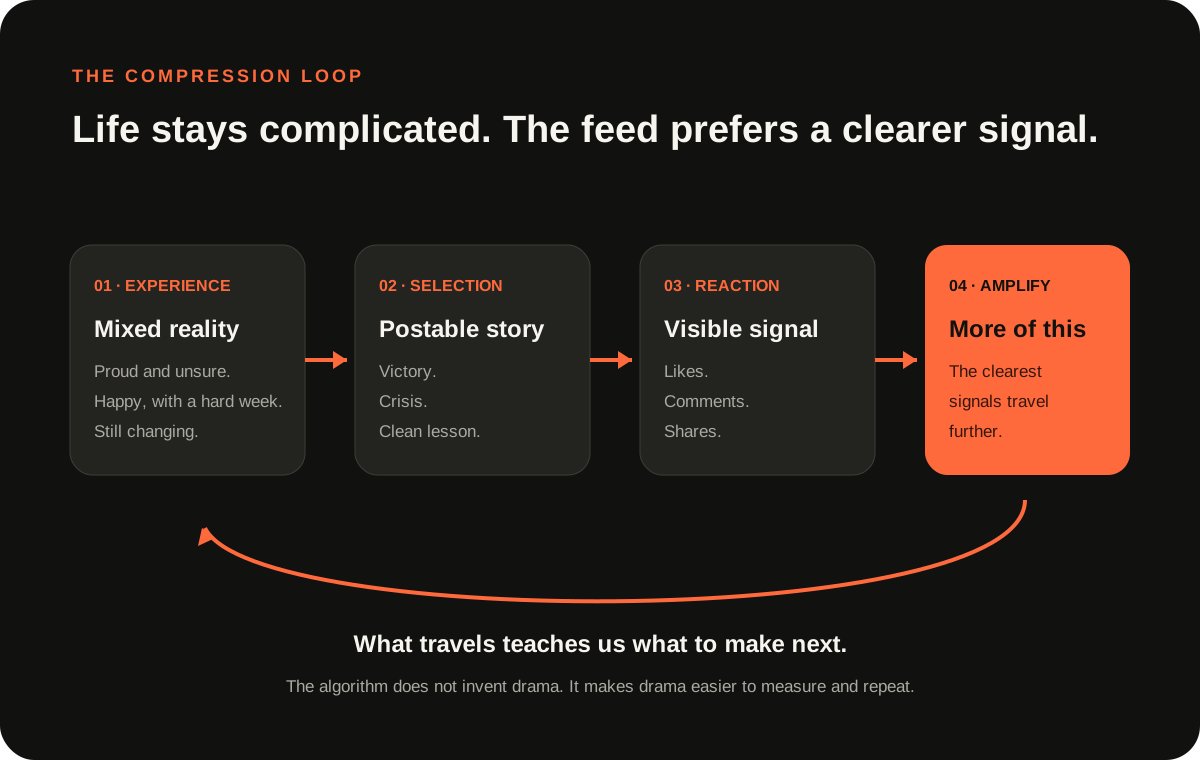
The algorithm does not invent our attraction to extremes.
It industrializes it.
What travels teaches us what to make next. Eventually, the distribution system starts editing the experience before we have finished having it.
Over time, this can influence not only what gets distributed but what gets created. We learn which opening holds attention, which opinion produces comments and which version of our own life people recognize most easily.
We begin anticipating the feed before we have finished experiencing the moment.
We are publishing the lesson before life has finished teaching it
Nuance takes time.
It uses phrases such as:
- It depends on the conditions.
- This worked for me, but it may not generalize.
- I agree with the principle and disagree with the implementation.
- Two apparently opposing things may both be true.
- I do not know yet.
Short-form content benefits from immediate comprehension:
- Do this.
- Never do this.
- This changed my life.
- This is why you are failing.
- Everything you know about this is wrong.
The problem is not only that attention spans may be under pressure. It is compression pressure. When an idea must be condensed, qualification is often the first thing removed.
Time is also compressed at the level of experience.
Previously, we might experience something, allow it to settle and eventually decide what it meant. Now there is an incentive to narrate the experience while it is happening.
We no longer wait for experiences to become wisdom. We convert them into content while they are still becoming experiences.
The clean lesson may arrive before the complicated reality has had time to disagree with it.
AI can now manufacture certainty before lunch
AI enters this system as an accelerator, not necessarily as its creator.
My reading of the current research, combined with what I see in content production, is that generative AI can strengthen the pressure in three ways.
First, it increases content volume. More people can publish polished material more frequently, making attention even more competitive.
Second, it reproduces familiar content architecture efficiently: strong hook, clear contrast, numbered principles, confident conclusion.
Third, it can smooth away the irregularities that make a thought personal. Emerging research on 2,200 college-admissions essays suggests that AI-generated writing can perform well individually while adding less diversity at the collective level. That is a bounded finding about one kind of writing, not proof that every AI-assisted thought becomes generic.
The risk is not only a flood of bad content.
It is a flood of competent sameness.
AI can also support nuance. We can ask it for counterarguments, missing stakeholders, alternative explanations and evidence that would change our mind. It can help us articulate a mixed feeling rather than forcing it into a side.
The difference is how we use it.
AI can help us think more deeply, or help us manufacture certainty more efficiently.
That is why metacognition matters. Before accepting a polished position, we should ask whether AI clarified a thought we had or supplied an identity-ready conclusion we simply recognized as impressive.
How to make room for an unfinished thought
The solution is not to post every uneventful lunch or turn social media into an unedited stream of consciousness.
Authenticity is not the absence of selection.
We can begin by changing what we consider worth expressing.
Share what you are learning before it becomes a universal lesson.
Say which conditions made advice work for you.
Allow two feelings to remain in the same paragraph.
Distinguish observation from conclusion.
Leave room for “I do not know yet.”
| Before posting | A more honest version |
|---|---|
| “This changed everything.” | “This changed one assumption. I am still testing the rest.” |
| “Here is the lesson.” | “Here is what seems true under these conditions.” |
| “You must choose a side.” | “The trade-off matters more than the label.” |
| “I finally figured it out.” | “I understand the question better than I did last month.” |
When consuming content, notice whether the feed is showing reality or only the parts of reality best equipped to survive the feed. Ask what might be missing between the victory and the collapse.
And when using AI, ask it to preserve uncertainty rather than automatically resolving it. Request the strongest case on both sides. Ask which assumptions drive the answer. Ask what evidence is missing. Then decide what you actually think.
Social media did not eliminate the middle of human experience.
It made the middle less visible.
Our ordinary, uncertain and contradictory lives still exist. They continue in private conversations, unfinished notebooks, quiet walks and all the days that never become posts.
Perhaps authenticity is not sharing everything.
Perhaps it is resisting the pressure to turn everything into a victory, a tragedy or a lesson.
Life is not binary.
The feed simply has trouble rendering the space between zero and one.
Further reading
-
Claire E. Krause and colleagues, Active Social Media Use and Its Impact on Well-Being.
-
A. H. Salopek and colleagues, Toxic Positivity Intentions.